

Alice down the proverbial rabbit hole: curiosity, consciousness, and the cost of endless descent
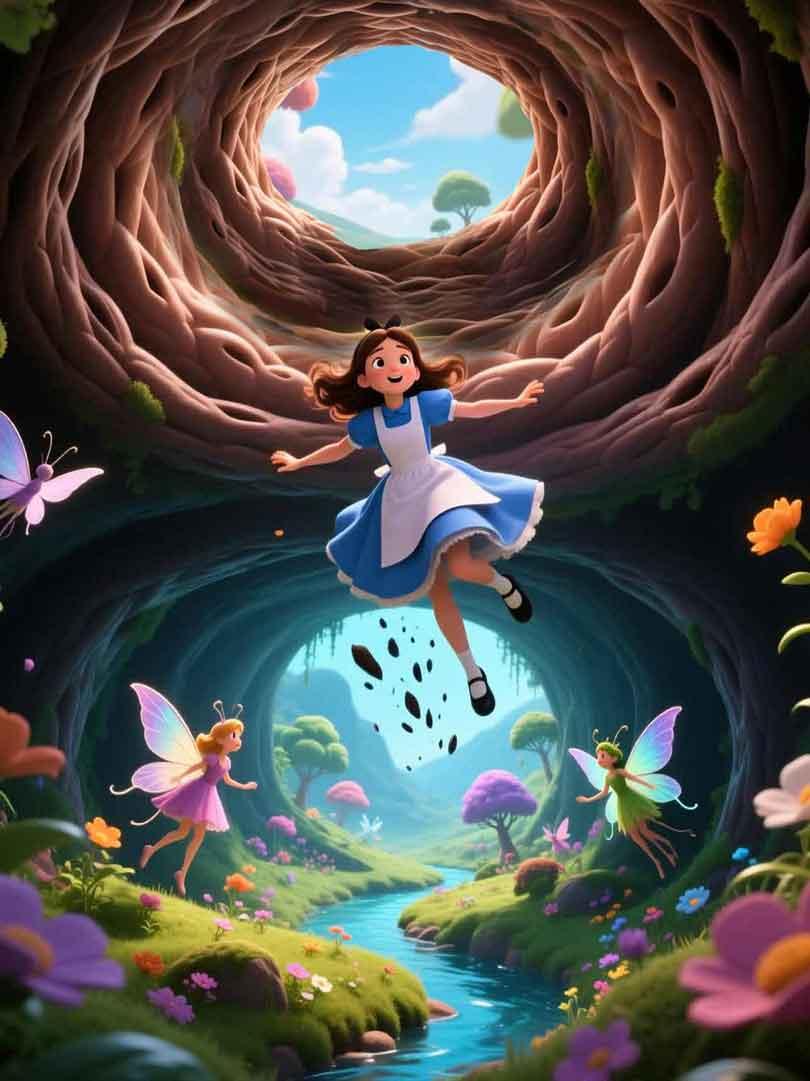
There are few images in literature as striking and enduring as that of a curious young girl tumbling headlong down a rabbit hole into a world that defies logic and expectation. When
Lewis Carroll first wrote Alice’s Adventures in Wonderland in 1865, he anchored his narrative with this simple yet evocative moment: Alice sees a white rabbit, follows it into its burrow, and begins a fall that will forever alter her sense of reality. Over the decades, the rabbit hole has become more than a plot device; it has evolved into a powerful metaphor for those moments when we cross a threshold, intellectually, emotionally, or culturally, and find ourselves in unfamiliar territory, uncertain of the rules that govern it.
At its most immediate level, the rabbit hole symbolises a gateway into a new world. It marks the point at which the ordinary gives way to the extraordinary, when curiosity overrides caution and the familiar surface of life fractures to reveal something stranger beneath. Crucially, Carroll does not rush this transition. Alice does not plunge and arrive; she falls for a long time. During this descent she has space to observe her surroundings, to make guesses that turn out to be wrong, to drift into daydreams, to snack, to speculate about distant places, and to hover between alertness and sleep. The journey itself becomes somewhat of a suspended state, being neither here nor there, where thought wanders and certainty dissolves.
Psychologically, this prolonged fall has long invited deeper interpretation. The rabbit hole can be read as a passage into the subconscious, a symbolic descent into the inner world where logic loosens its hold and contradictions coexist. Wonderland, with its elastic rules, shifting identities, and distorted authority figures, reflects the workings of the mind itself. Alice’s frequent confusion about who she is, her fluctuating size, and her struggle to impose meaning on nonsense mirror the experience of navigating unfamiliar mental or emotional terrain. In this reading, the rabbit hole is not merely an entrance to fantasy, but a metaphor for the mind exploring itself, an unsettling yet necessary process of self-awareness.
From time to time, the metaphor has even been tentatively linked to science. Theoretical physicists have speculated about wormholes: hypothetical tunnels through space-time that could connect distant regions of the universe. Like the rabbit hole, a wormhole suggests sudden transition and emergence into an unexpected realm. Yet the resemblance ends there. Wormholes remain mathematical possibilities rather than observed realities, and no scientific evidence confirms their existence. Their relevance lies less in physics than in what their popularity reveals about us: a deep-seated human intuition that reality may contain hidden passages, and that understanding often requires venturing beyond the visible surface.
It is in the digital age, however, that the rabbit hole has acquired its most contemporary, and most troubling, meaning. Writer Elaine Zelby once asked why this particular image has endured. Why do the youth of today not speak of being “caught in the spider’s web” or “trapped in the beaver’s dam”? Her answer was telling. The rabbit hole, she observed, captures something those images do not: time spent in transit. Alice’s fall is long, absorbing, and filled with passing distractions. She is not immediately delivered to a destination; she drifts. This, Zelby noted, uncannily resembles our experience online - scrolling, clicking, watching, and reading, suspended in an attentional free fall with no clear endpoint.
For today’s generation, the rabbit hole has become both a justification and an alibi. “I fell down a rabbit hole” is now offered as a casual explanation for hours lost to screens, tasks deferred, and responsibilities postponed. The metaphor, once associated with wonder and discovery, is increasingly used to excuse zoning out and chronic procrastination. Curiosity, which once propelled Alice forward, is diluted into distraction. Exploration becomes passive consumption. The fall continues, but the awakening is delayed.
This is not an argument against intellectual wandering. Genuine exploration - following an idea across disciplines, losing oneself in research, allowing curiosity to lead beyond one’s comfort zone - remains one of the great engines of learning and creativity. Many breakthroughs, personal and intellectual, begin precisely where certainty ends. The problem arises when the language of exploration is used to mask avoidance, when depth is replaced by drift, and when the rabbit hole becomes a place to hide rather than to discover.
Alice’s story ultimately offers a corrective. She does not remain in free fall forever. She questions Wonderland. She challenges its absurdities. She learns to assert herself within it. And eventually, she wakes. The enduring power of the rabbit hole lies not in the fall itself, but in what follows: the capacity to emerge with greater clarity about oneself and the world.
In an age of infinite tunnels and endless descent, the lesson is not to seal the rabbit holes, but to enter them consciously. Curiosity must be paired with intention, and exploration with responsibility. Otherwise, we risk confusing movement with progress, and mistaking prolonged descent for meaningful depth - falling, like Alice once did, without remembering why we followed the rabbit in the first place.