“Paint Me Lighter, Call Me Worthy” Colourism in Sri Lanka

I grew up in a community where kids bullied each other or treated one another differently based on skin colour. I often saw young girls cry because they said they had no friends at school. But this behaviour didn’t come only from children. At times, even teachers showed favouritism towards lighter-skinned students, especially during school events, choosing them over others instead of giving opportunities based on talent.
Unfortunately, these biased mindsets have gone too far to be easily changed. They have been ingrained for decades and are now even used for business. I also faced negative treatment because of colourism, but I was never deeply affected by it. Still, as colourism rises in our country, I refuse to stay silent. I will speak up and fight for health, identity, and diversity. In 2023, I noticed girls at my school and tuition classes appearing greyish-white, not naturally light-skinned. My friends and I often talked about it.
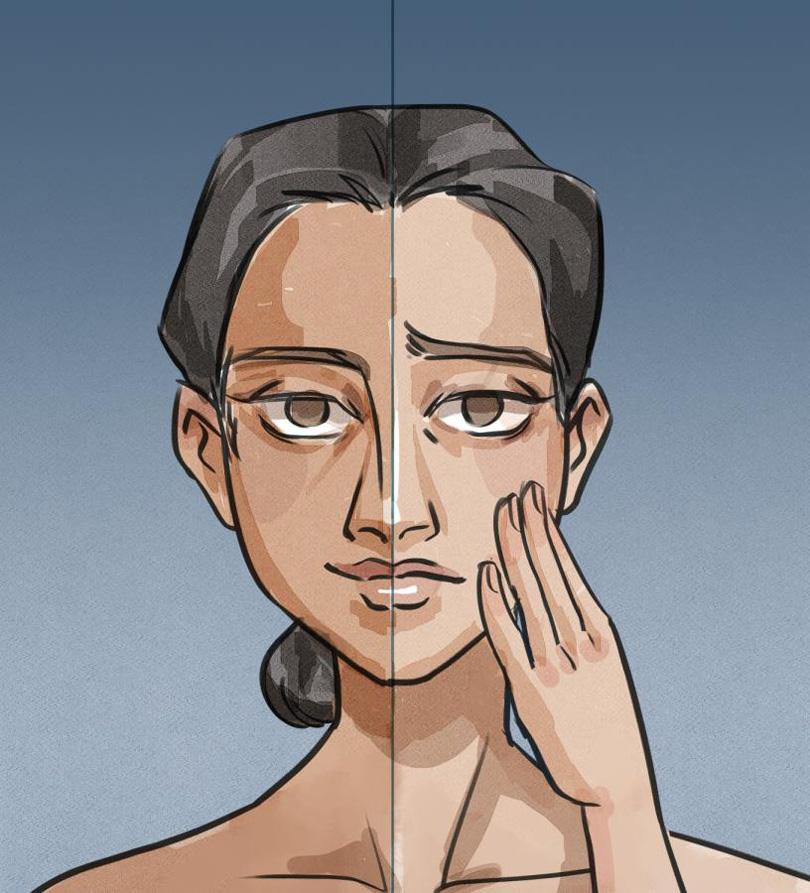
Recently, I came across an advertisement on Instagram for tablets aimed at whitening the skin of teenage girls under 17. They claimed these beauty pills were safer and more suitable than whitening creams. The advertisement cleverly avoided using the phrase “whitening tablets.” Instead, it used subtle language to hide its true intention. In their commercials, they replaced a brown-skinned girl with a white girl to show the “before and after” effect. The message is clear, even if it isn’t directly stated: lighter is better.
The hypocrisy becomes worse when they encourage mothers, who should be a safe space for their daughters, to reach out and complain about their daughters’ darker skin. Some of the messages the company claims to have received from mothers, translated from Sinhala, include:
“My daughter’s skin is a little dark, but she has a beautiful and elegant look.”
The product is marketed as a safe beauty method designed especially for girls under 17. It emphasises that it contains all the nutrients needed for a “golden complexion.” The claims include preventing acne, controlling oiliness and dryness, maintaining a balanced pH, and removing discolouration and blemishes such as sunburn.
To validate their claims, they introduce professionals labelled as “Western Doctors,” as if that title alone guarantees trust. Stop creating insecurities and ruining the identity of teens for profit.
Let’s be honest. This isn’t about skincare, health, or confidence. This is business, a calculated model built on making young girls feel inadequate in their own skin. What’s even more alarming is how early they are being targeted. Under 17. At that age, a girl is still figuring out who she is, what she likes, and how she fits into the world. Before she has a chance to accept herself, she is already being told she needs to change.
That isn’t beauty culture. That’s conditioning, trapping young people in unrealistic and delusional beauty standards.
We like to think that colourism is an outdated problem, something from earlier generations. But it is still here. It has simply evolved. It is now more subtle, more polished, and more dangerous. Instead of saying “you are too dark,” it hides behind words like “glow,” “brightening,” “radiance,” and “golden complexion.” It sounds gentle and caring, but the message remains the same: lighter is better.

What is even more concerning is how normalised this has become within families. When mothers start seeing their daughters’ skin tone as something that needs fixing, the damage runs deeper. It is no longer just society influencing a girl; it is her home too.
A home should be a place of safety and acceptance. But when a girl grows up hearing suggestions like “maybe you should try this” or “you would look prettier if…,” those words settle in. They begin to shape how she sees herself.
Confidence does not disappear overnight. It erodes over time.
We also need to question the so-called science behind these products. Simply using terms like “nutrients,” “pH balance,” and “dermatologically tested” does not make something safe, especially if the goal is to change a natural skin tone. There is a clear difference between taking care of your skin and trying to change its identity. One is self-care. The other is self-rejection disguised as improvement.
And why is darker skin always seen as something that needs correction? Why is there no urgency to “fix” lighter skin? Why is fairness still marketed as an achievement? Somewhere along the way, we accepted a standard that was never truly ours.
This obsession has been reinforced through media, films, advertisements, and everyday conversations. The heroine is often fair. The “beautiful” girl is usually light-skinned. Compliments are still tied to fairness, with phrases like “you’ve become so fair” treated as praise.
Then we wonder why young girls chase that standard.
What these companies are doing is exploiting an insecurity that already exists. They didn’t create it, but they are taking advantage of it without hesitation. Replacing a brown-skinned girl with a white girl in advertisements is not just misleading, it is harmful. It sends the message that the “after” is more acceptable, more desirable, and more valuable.
This is where we need to draw the line.
This isn’t just about appearance. It is about identity. It is about telling an entire generation that who they are naturally is somehow less valuable. That is not something we should accept.
We need to start questioning these narratives instead of consuming them blindly. Young girls should learn that their skin is not a problem that needs solving. It is part of who they are. It reflects their heritage, individuality, and uniqueness.
At the same time, we need to hold brands accountable. An attractive marketing campaign does not make something ethical. Mentioning the word “doctor” does not make it trustworthy. We need stricter regulations, especially for products aimed at minors. There cannot be space for manipulation when it comes to something that affects both physical and mental health.
However, the responsibility does not fall only on companies or authorities. It lies with us as well. The way we speak, the compliments we give, and the standards we uphold either break or continue this cycle. If fairness continues to be praised, colourism will continue to survive. This is where the conversation needs to change.
Instead of asking girls how they can become fairer, we should ask why fairness is still seen as a goal. Instead of promoting transformation, we should encourage acceptance, real acceptance, not the kind that depends on meeting certain conditions. Because no tablet, cream, or serum can give someone self-worth. That comes from within and from the environment we create around them.
If a girl grows up feeling valued and confident in her own skin, no advertisement will define her. But if she grows up constantly being told she needs to change, even the smallest suggestion can affect her deeply. So, this needs to be said clearly. Stop targeting young girls. Stop selling insecurity. Stop disguising colourism as care. And to every girl who has ever looked in the mirror and felt she was not enough because of her skin tone, unlearn that belief, slowly, but surely. You were never the problem. The system was. It is time we start challenging it instead of changing ourselves to fit into it. We owe that much to ourselves and to the generations that come after us.