WHEN LOVE REFUSES TO DIE: THE HAUNTING OF THE WOMAN IN BLACK
BY SHALEEKA JAYALATH
 There are ghost stories that startle you for a moment and then politely release you back into the safety of your own well-lit life. And then there are ghost stories that linger. The Woman in Black, the gothic tale written by Dame Susan Hill in 1983 and later adapted for the stage by Stephen Mallatratt, belongs firmly to the latter category. It does not simply frighten; it unsettles. It does not rely on spectacle; it relies on suggestion. And in doing so, it reminds us that the most enduring terrors are those we conjure ourselves.
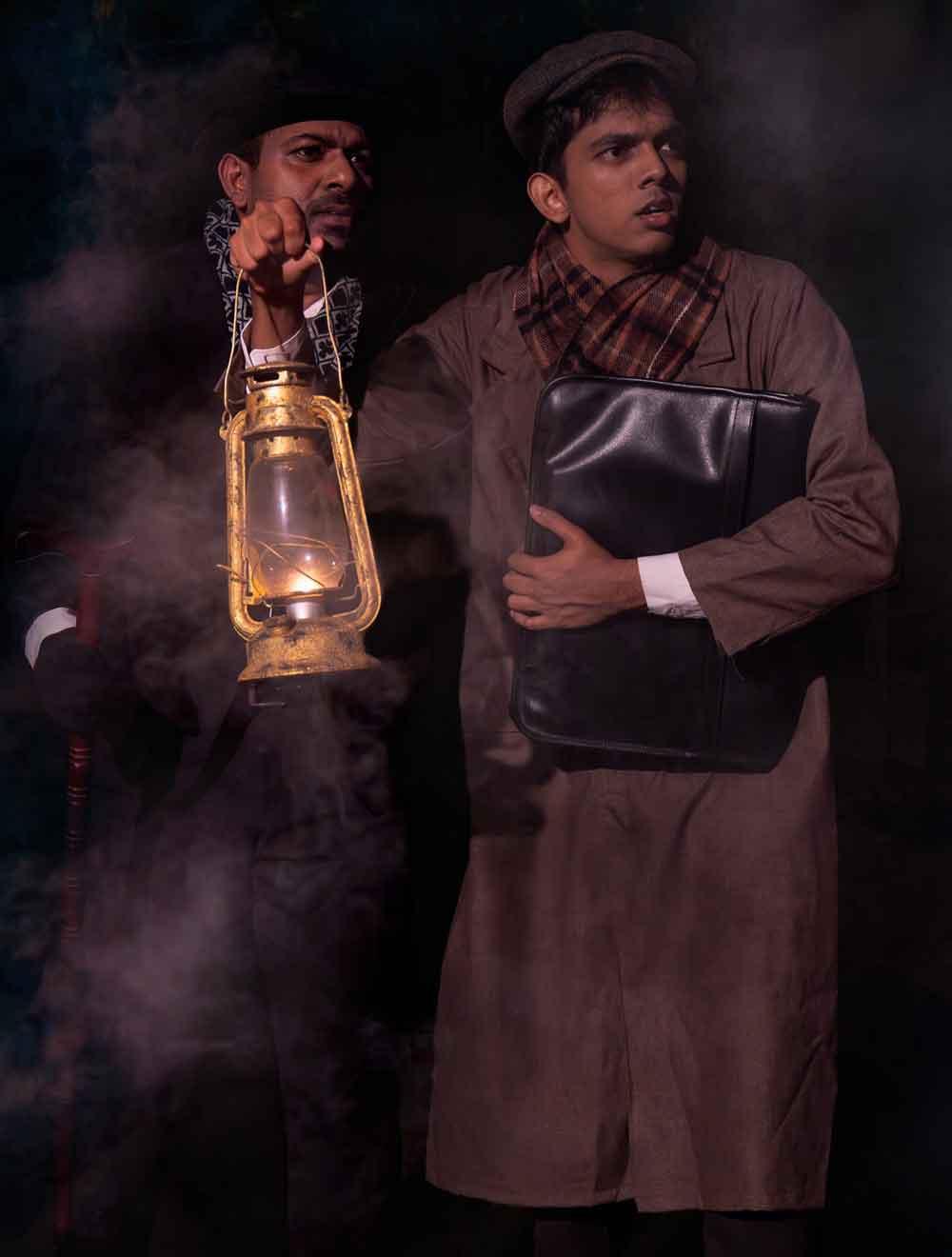
In the hands of Cue Theatre, this stark two-man play becomes something more than imported gothic horror. It becomes an exercise in imagination, restraint and trust - trust in text, in actors, and in an audience willing to lean into the dark. Directed by the company’s founder Ranga Jayaratne, this production revisits a play first staged by Cue Theatre in 2019. But Jayaratne is quick to insist that this is not a mere repeat performance. The set will shift. The rhythms will alter. Most crucially, the actors inhabiting the roles are different, and in an atmospheric play such as this, difference changes everything.
At its core, The Woman in Black is a “good ghost story”, according to its director. Yet what Jayaratne loves most is not the fright; rather, it is the way the play carries you away with your own belief. Theatre here is stripped of glitz and glamour. There are no cinematic tricks to hide behind. Instead, there is the fragile contract between performer and spectator, where the former enacts just enough to be met halfway with the latter’s imagination. In an age intoxicated by digital excess, there is something almost rebellious about that.
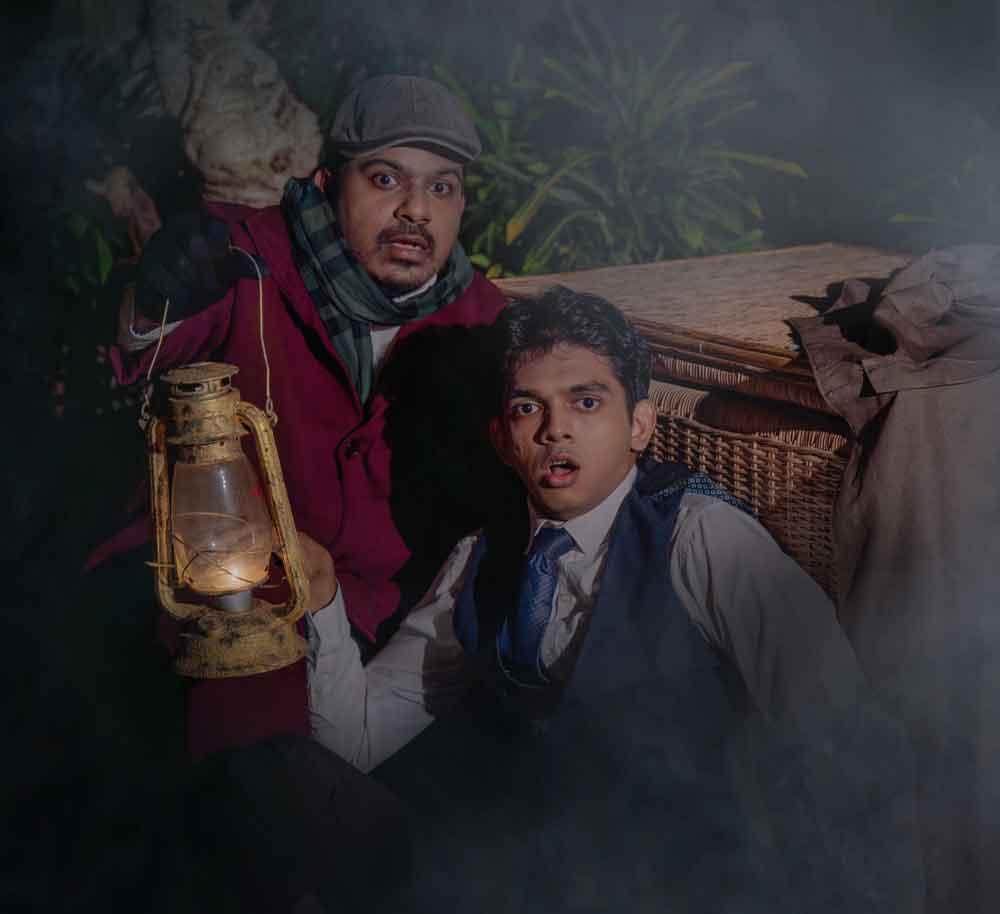
The story follows Arthur Kipps, a solicitor compelled to recount a traumatic episode from his youth involving a desolate house, a grieving woman and a curse that has lingered for nearly fifty years. In this production, Kipps (along with five other characters) is played by Lahiru Fernando, who has been with Cue Theatre since its inception in 2012. The role demands not only stamina, but agility: six distinct personalities, six emotional registers, all embodied by one actor navigating shifting sands of fear and memory.
Fernando admits, almost sheepishly, that he is afraid of the dark. There is something poetic about that. To play a man haunted by shadows while privately unsettled by them is to stand at the edge of one’s own discomfort. Yet he speaks of how inhabiting Kipps has helped him confront that fear. More revealingly, he speaks of perspective. Playing multiple characters has forced him to see how different individuals interpret the same event, how trauma fractures perception. It is a quiet education in empathy, one that theatre uniquely provides. Personally introverted, Fernando confesses that he rarely opens up beyond a close circle of friends. Kipps, however, must relive and re-enact his experiences, exposing his vulnerability before an audience. In that tension, between the private man and the public retelling, lies growth. Both he and Jayaratne note an increase in his confidence, not just as an actor but as a person willing to step into darkness rather than recoil from it.
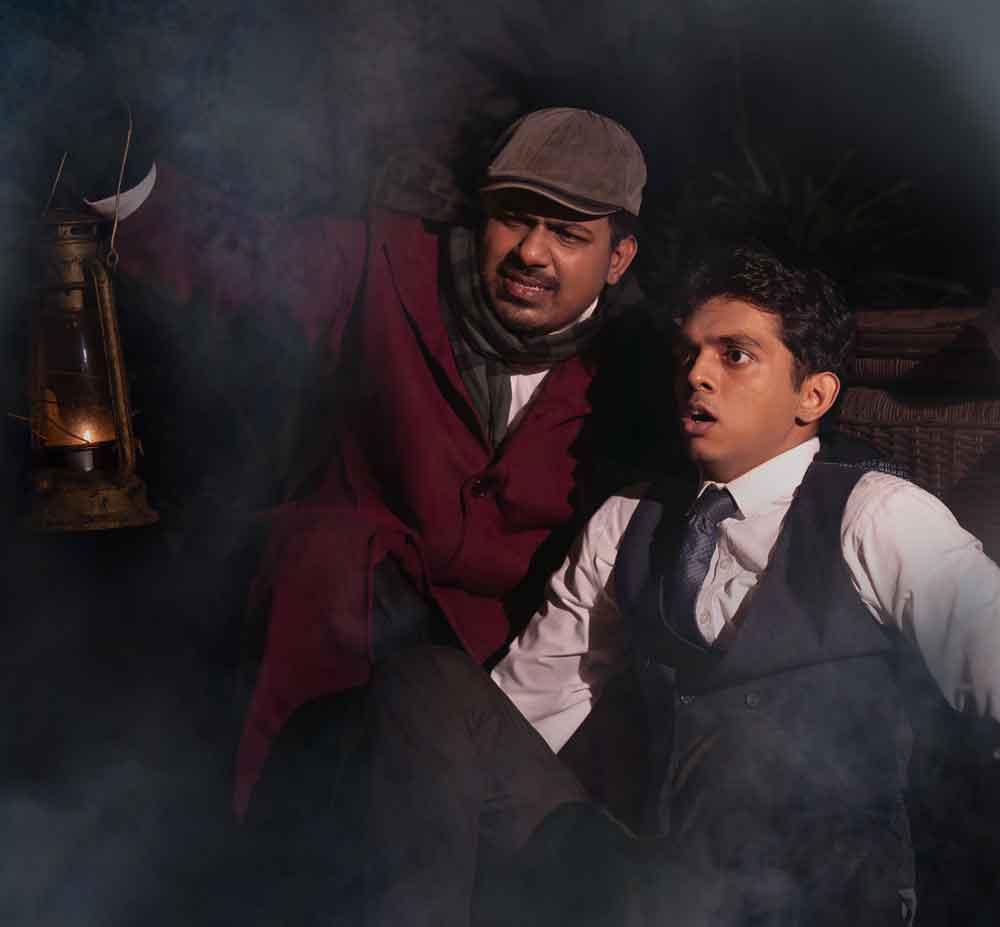
Opposite him stands Aaron Henderlin, a young actor in his early twenties who joined Cue Theatre in 2018. Henderlin plays “the Actor”, a figure who agrees to help Kipps dramatise his tale, and who in turn enacts Kipps as he sees him. It is a layered role: an actor playing an actor playing Kipps. Youthful eagerness becomes an asset here. Henderlin’s passion for theatre bleeds into his performance, mirroring the character’s own enthusiasm to transform a stiff narrative into living drama. He describes himself as an aspiring method actor, unafraid to explore emotional discomfort. Ironically, he claims to be frightened by almost everything, ghost stories in particular unsettling him deeply. To find himself inside one, night after night, is no small challenge. Yet that vulnerability enriches his portrayal. Fear, when acknowledged rather than denied, becomes fuel.
Jayaratne herself faces a different kind of pressure. Despite being a seasoned director, having produced regularly under the Cue banner since 2012, this iteration has been mounted in a mere four weeks. Logistics, rehearsals, design, coordination: all compressed into a tight frame. Characteristically hands-on, she immerses herself in every aspect of production. It is a reminder that theatre, for all its ephemeral magic, is built on discipline and relentless labour.
There is also, as with many of Jayaratne’s works, an undercurrent of love. She has a penchant for dark endings and believes tragedy lingers longer with audiences than tidy happiness. Without spoiling the plot, she hints that love - twisted, broken, unhealed as it is - is what fuels the haunting. The ghost does not rise from malice alone but from heartbreak. The curse that shadows innocent lives for decades is born of loss. Innocence, safety, the desperate human wish not to be afraid - all are stripped bare.
Cue Theatre itself operates like an extended family. Its members, from varied backgrounds, describe themselves affectionately as misfits who found belonging under its roof. Theatre becomes comfort, communion, even therapy. Jayaratne, who began her career as a teacher at seventeen, believes the stage teaches today’s generation what few classrooms can: empathy, teamwork, discipline, integrity, and the simple but radical act of showing up for one another. She does not coerce discomfort, but she does encourage growth. Fernando recalls earlier roles that forced him to confront personal grief, leaving him emotionally drained yet profoundly changed. That trust between director and actor is palpable.
So, what awaits audiences on the 13th, 14th and 15th of March at the Namel Malini Punchi Theatre? Not spectacle for spectacle’s sake. Not easy thrills. Instead, an invitation: to sit in the dark and listen; to allow imagination to do what special effects cannot - to consider how love, when warped by loss, can echo across generations.
Prepare, certainly, to be frightened. But prepare also to be moved. For in The Woman in Black, the most chilling presence is not the ghost herself. It is the stubborn persistence of love that refuses to die.