MINOLI WICKRAMASINGHE CAPITAL TRUST HOLDINGS LIMITED
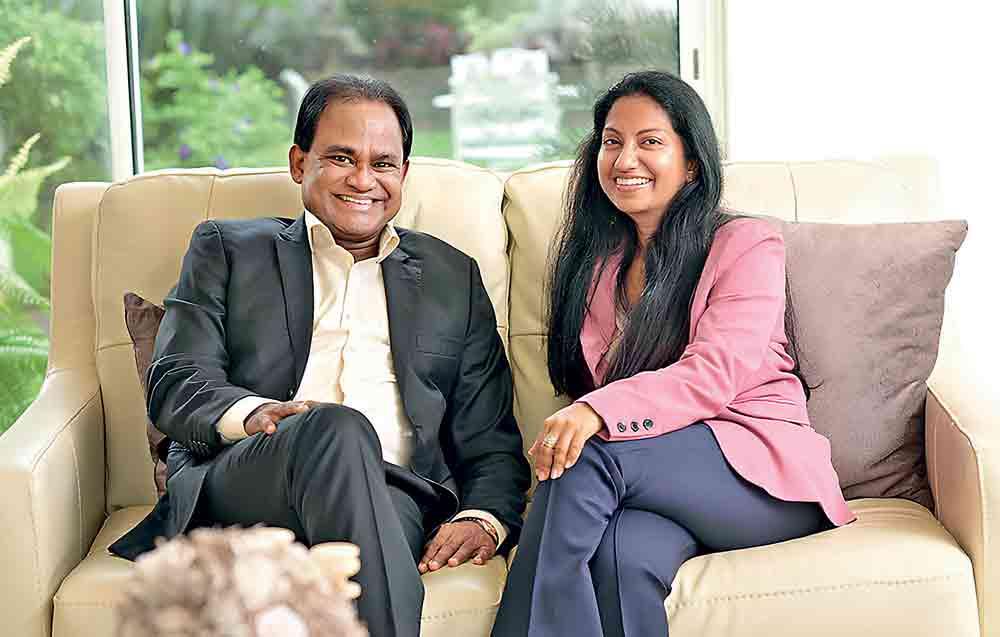
Minoli Wickramasinghe stands as one of Sri Lanka’s most accomplished and resilient business leaders, bringing together decades of experience across banking, logistics, corporate training, and real estate. As Executive Director of Capital TRUST Holdings Limited and Chairperson and CEO of its Real Estate cluster, she operates at the forefront of an industry that plays a critical role in shaping economies and societies. Known for her clarity of thought, strong ethical compass, and ability to lead through uncertainty, Minoli has built a reputation as a trusted advisor and a credible voice in the real estate sector.
Her career journey reflects both courage and adaptability, from starting out as the youngest trainee in a leading development bank to navigating male dominated corporate environments and ultimately leading one of the country’s most influential real estate advisory platforms. In this interview, she reflects on her professional journey, leadership philosophy, the evolving real estate landscape in Sri Lanka, and the legacy she hopes to build for future generations.
Q You currently lead the Real Estate cluster at Capital TRUST Holdings. What does your role involve, and what excites you most about this sector today?
I currently serve as the Chairperson and CEO of the Capital Trust Properties cluster, which is a highly demanding role that requires balancing strategy, leadership, and accountability. As the market leader in real estate transaction and advisory services, we engage with a wide range of stakeholders including developers, investors, regulators, financial institutions, and clients from both local and international markets. One of the most critical aspects of my role is ensuring that the advice we give is accurate, ethical, and forward looking, because our clients place extensive trust in our judgment. What excites me most about the real estate sector today is its transformative potential. Real estate is not merely about transactions. It is about enabling investment, supporting economic growth, and shaping the way people live and work. Despite the challenges Sri Lanka has faced in recent years, I see real estate as a powerful driver of recovery and long-term development, particularly if supported by the right policies and investor confidence.
Q Looking back at your early career at DFCC Bank and Maersk Lanka, what foundational lessons still influence your leadership style?
I began my career at DFCC Bank as the youngest trainee at the time, which in itself was a challenging experience. From the very beginning, I learned the importance of discipline, analytical thinking, and integrity. DFCC exposed me to development finance and taught me how financial decisions can have far reaching impacts on businesses and the economy. My time at Maersk Lanka was equally formative, if not more intense. I worked in a male oriented industry and held a challenging role as the only finance professional in the Sri Lankan office, reporting to multiple global offices. This environment pushed me to develop confidence, resilience, and precision. I learned how to perform under pressure, how to communicate clearly across cultures, and how to stand my ground professionally. These early experiences shaped my leadership style and gave me the perseverance and mental strength that continue to guide me today.
Q You have held leadership roles across banking, logistics, training, and real estate. How did these diverse experiences shape the executive you are today?
Having such diverse professional exposure has been a tremendous advantage. Each sector taught me something unique, and together they have shaped the way I approach problem solving and leadership. When you have seen how different industries operate, you develop the ability to connect ideas and identify solutions that others may overlook. These experiences also taught me not to give up easily. Many challenges that seem insurmountable at first can be resolved if you approach them with creativity and persistence. I also believe my background helped me develop a supportive and inclusive leadership style. I understand the value of people, and I believe strongly that an organization’s strength lies in its employees. By empowering teams and creating an environment of trust, I have been able to attract and retain talented individuals who have become the backbone of our success.
Q You were the Founder Director and Head of Corporate Training at Skills Lanka Limited. What inspired you to move into corporate training at that stage of your career?
I was very young when I became involved with Skills Lanka Limited, working closely with my father. That experience gave me exposure that I would never have gained within a single organization. At Skills Lanka, I was responsible for managing accounts, coordinating training programs, and conducting training needs assessments for corporate clients. This required me to visit a wide range of companies and understand their cultures, structures, and operational challenges. Coming from a family deeply rooted in education, I have always had a passion for learning and development. Corporate training allowed me to combine that passion with practical business impact. It was incredibly rewarding to see how targeted training could improve performance, productivity, and confidence within organizations. Education remains a sector close to my heart, and it is an area I would like to expand further in the future.

Q Skills Lanka worked with several large organizations in Sri Lanka. What skills gaps did you identify in the local corporate sector, and how did you address them?
Through our work with large organizations such as CIC, Baurs, Delmege, Stretchline, and Bodyline, we identified several recurring skills gaps across different levels of the workforce. At the management level, communication gaps and leadership challenges were common. Many technically strong managers struggled with people management and effective communication. At the operational level, we often found inefficiencies caused by repetitive or unnecessary tasks. By analyzing workflows and job functions, we were able to recommend the removal or redesign of certain roles, which immediately improved efficiency and morale. Addressing these gaps required a practical and customized approach rather than generic training programs. Our focus was always on aligning skills development with business objectives.
Q Having studied in Nigeria, Australia, and Hong Kong, how has this international exposure influenced the way you approach business decisions in Sri Lanka?
Studying abroad during my formative years had a profound impact on my outlook and confidence. Exposure to different cultures, education systems, and ways of thinking made me adaptable and open minded. It also helped me develop the ability to engage comfortably with people from diverse backgrounds, which is invaluable in business.
As a female leader, this international exposure has also strengthened my confidence in male dominated environments. I rarely feel intimidated, because I rely on my expertise, professionalism, and preparation. I believe strongly in standing my ground and not giving up easily, especially when I know I am right. These qualities continue to influence the way I negotiate, lead, and make decisions in Sri Lanka’s complex business landscape.
Q As head of the Real Estate cluster, how do you view the role of real estate in driving economic recovery and long-term growth in Sri Lanka?
Real estate is one of the most important asset classes in any economy. It drives investment, employment, infrastructure development, and wealth creation. In Sri Lanka, however, we have not fully leveraged the potential of this sector due to the absence of consistent and positive economic policies. Countries such as Dubai have demonstrated how real estate can be used strategically to attract foreign direct investment and stimulate economic growth. Sri Lanka has similar potential, but it requires policy stability, transparency, and investor friendly regulations. If approached correctly, real estate can play a central role in the country’s economic recovery and long-term development.
Q What emerging trends do you see in the Sri Lankan real estate market, especially post crisis?
After experiencing multiple crises including the pandemic, financial instability, and political uncertainty, Sri Lanka saw very little new development activity for nearly four years. During that period, there was a perception of oversupply in certain segments, particularly residential condominiums. However, what we are witnessing now is the impact of pent-up demand. With renewed confidence and gradual economic stabilization, there is now a noticeable shortage of quality residential apartments and commercial spaces. This presents significant opportunities for developers and investors who are willing to take a long-term view. The market is entering a phase where demand is likely to outpace supply, especially in well planned developments.
Q What advice would you give young women aspiring to leadership positions in finance, real estate, or corporate management?
My advice is simple but deeply personal. If you have the will and the passion, you can achieve whatever you desire. There will be obstacles, self-doubt, and external resistance, but perseverance and confidence in your abilities will carry you forward. Never underestimate the power of preparation, professionalism, and integrity.
Q Looking ahead, what legacy would you like to build both within Capital TRUST Holdings and in the broader business community?
My vision is for Capital TRUST Holdings to evolve into a truly global conglomerate that serves its stakeholders ethically, professionally, and sustainably. I want the organization to be known not only for its commercial success but also for its values and credibility. Beyond the company, I hope to contribute to a business culture that values integrity, competence, and inclusivity. If my journey can inspire others, particularly women, to pursue leadership with confidence and purpose, that would be a legacy I would be proud to leave behind.

- One word that best describes your leadership style Leading by example
- Your first job taught you what important lesson Perseverance
- Banking, logistics, training, or real estate. Which shaped you the most Real estate
- A habit every successful leader must develop Ethical professionalism combined with empathy
- The most valuable skill for today’s corporate professionals Passion and perseverance
- A leadership myth you strongly disagree with That unethical leadership can be sustainable
- One global business practice Sri Lanka should adopt faster Efficiency
- The best advice you’ve ever received Never procrastinate
- One quality investors look for beyond numbers Trust and consistency