Chanel Turns Your Daily Life into a Runway Even Where You Least Expect It
You’ve probably never thought twice about a supermarket aisle, an airport check-in line, or a subway platform. They’re places you move through half-awake, phone in hand, just trying to get from A to B, not exactly where you expect couture gowns or hand-embroidered tweed to appear. And yet, over the years, Chanel has quietly turned these very ordinary spaces into runways. A grocery store stocked with Chanel-branded pasta. Models lining up at a fake airport terminal. Barefoot walks along an artificial beach. Most recently, couture stepped onto a New York subway platform and very much the kind of place you’ve probably complained about at least once. It raises a simple, oddly compelling question: Why does one of the world’s most exclusive fashion houses keep returning to the most ordinary places we know?
Couture in Context
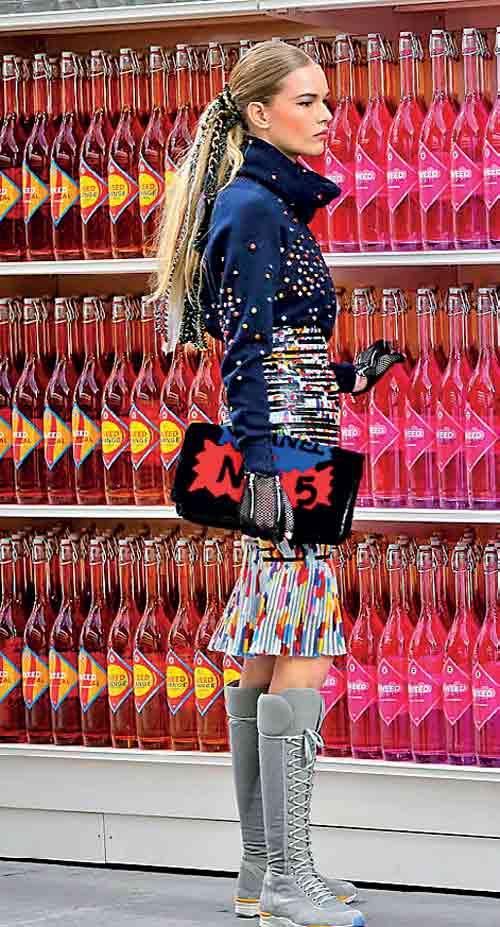
Couture in a supermarket. Not a metaphor, an actual supermarket with actual aisles, actual shelves stacked with Chanel-branded pasta, tea, and hand soap alongside models casually grabbing ham stamped with the iconic CC logo. At the Autumn 2014 show, models navigated the aisles, pushed customised carts and maybe even snagged a can of beans on the way, blending luxury with everyday grocery runs.
From luxury water bottles to sand between the toes, for the Spring/Summer 2019, Chanel decides, “Let’s make a beach… inside the Grand Palais.” Real sand, real water, lifeguard on duty. Models walk barefoot, casually juggling clear PVC double C slides like it’s no big deal, then climb stairs by the photo pit and finish along a boardwalk. Couture meets holiday chaos - and somehow, it totally works.
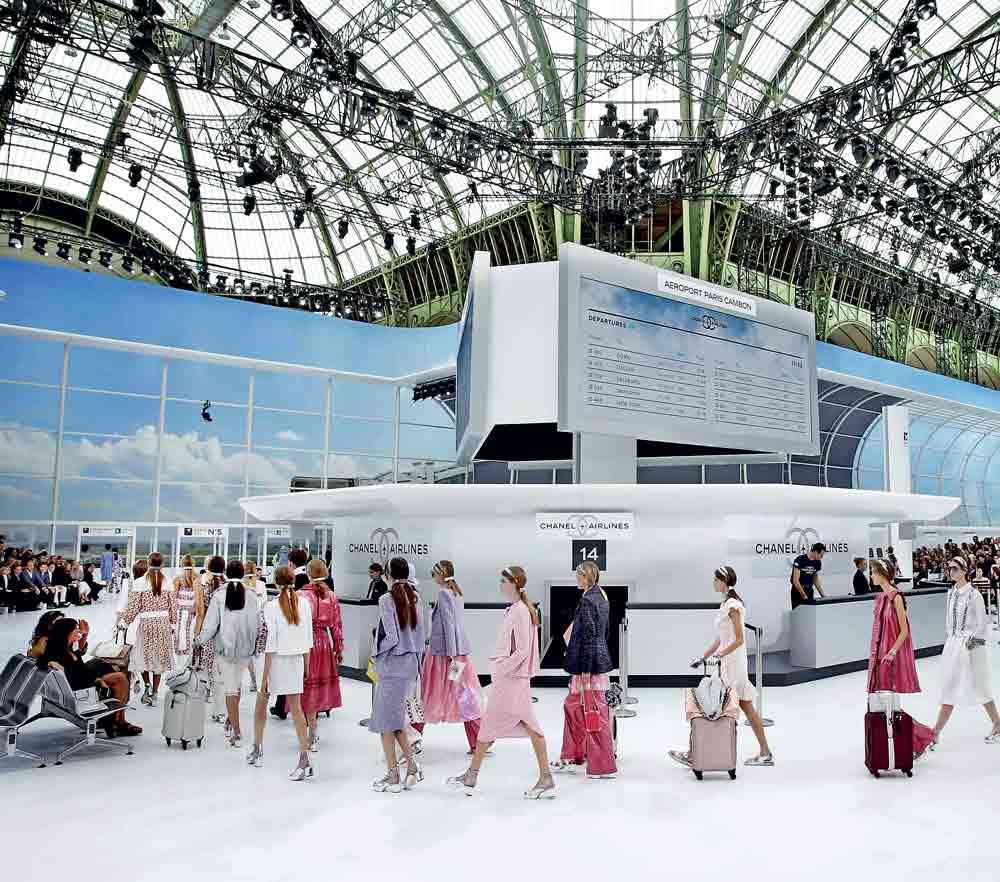
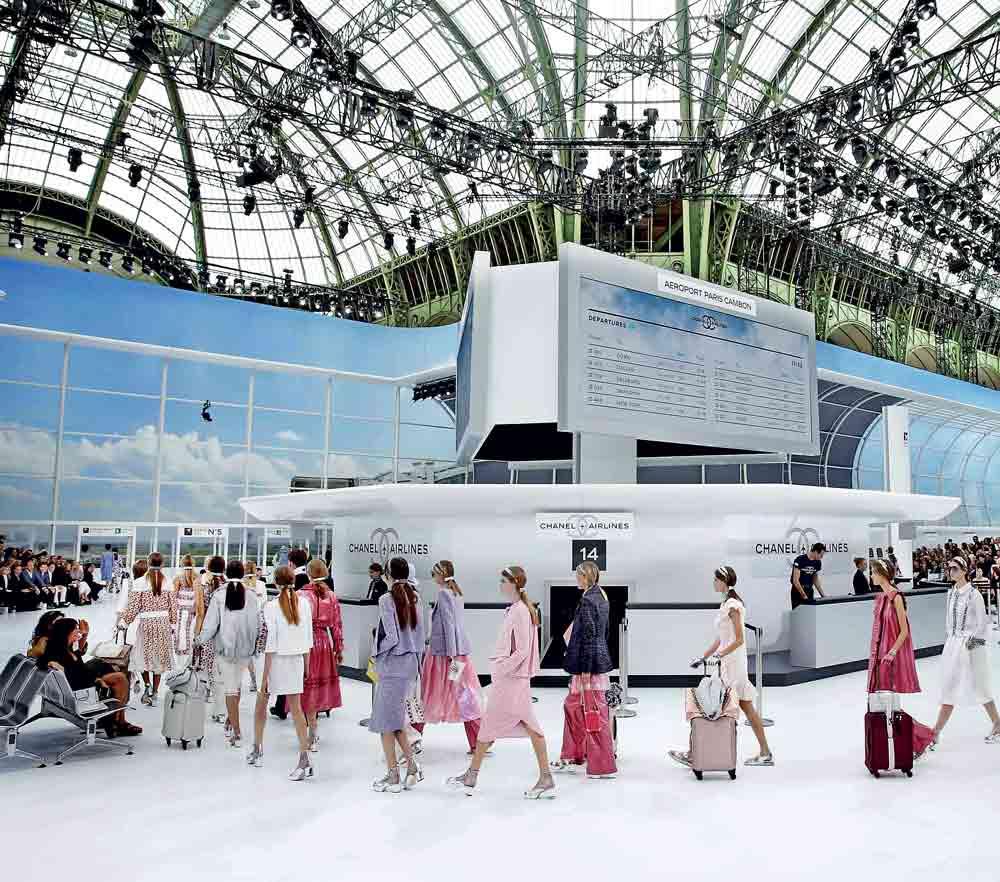
Airports, too, get the Chanel treatment. For Spring 2016, the runway becomes a full terminal and specifically Terminal 2C. Check-in desks, luggage belts, departure and arrival boards, and even boarding passes that read “Chanel Airlines”. Models strut past counters, carry-ons in hand, pretending to check in while rocking tweed skirts worth more than most of our monthly rent - meanwhile, the rest of us are basically in pyjamas by comparison.
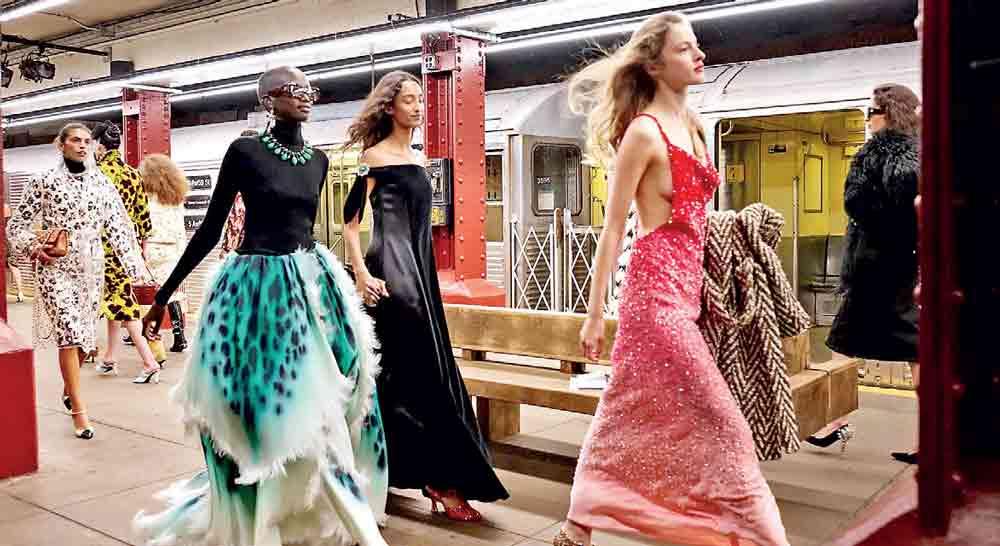
And the latest buzzed-about show of the season? The Métiers d’Art 2026 staged in an abandoned New York City subway platform - for Sri Lankan readers, imagine your local train station, rats optional. Models moved like commuters: a 70s journalist racing a deadline, an 80s businesswoman with a briefcase, a wide-eyed tourist in an “I NYC” tee, a classy older woman off to the opera, and yes, even Clark Kent sneaking his Superman emblem under a suit. They walked in and out of train cars or waited on platforms, reading newspapers, while leopard prints, beaded fish, candy-apple-red accents, Big Apple-inspired details, cat-head hats, dog motifs, and coffee cup handbags made appearances.

Other Chanel sets love a little sensory mischief. Take the Autumn/Winter 2015 brasserie: red leather booths, mosaic floors, steaming espresso, freshly baked croissants - and models casually sipping, flipping through newspapers, chatting with servers. The casino from the same year? Slot machines, gaming tables, sequined dresses, boxy jackets, and slingback heels - basically, haute couture meets Vegas glam. Even brains and tech get a runway: the Spring/Summer 2017 show transformed the runway into a giant data centre, with control panels and multicoloured wires lining the set. Models emerged from the machines into a stark white space, including stormtrooper-like figures. And apart from those, the Fall 2019, Spring/Summer 2020 and Fall 2000 couture shows got their own library, Paris rooftop and swimming pool setting. And as if that weren’t enough, Chanel also handed couture its own library, Parisian rooftop, and even a swimming pool - courtesy of the Fall 2019, Spring/Summer 2020, and Fall 2000 couture shows.
Testing Luxury Against Reality
Chanel’s decision to stage couture in ordinary, functional spaces isn’t meant to be random backdrops or visual jokes; they are places that structure modern life.
The supermarket, for instance, reflects routine and repetition. Karl Lagerfeld understood that even the woman in tweed and stilettos still buys groceries, but his interest went deeper than relatability. He imagined a version of luxury that doesn’t pause real life, but moves alongside it. By reworking corsetry into sportier, zip-heavy forms, he blurred the line between structure and comfort, fantasy and use.
The subway pushes this tension further. By choosing a disused Bowery Station instead of an iconic museum, Matthieu Blazy placed Chanel in a space where hierarchy breaks down. Subways are built on overlap: different social classes, professions, and routines moving through the same system, often at the same time. Couture walking through this setting isn’t about making fashion “accessible” in a literal sense, it’s about testing whether exclusivity can survive in a space that belongs to everyone, symbolising the space as a form of unity.
The giant computer data centre adds another layer. Lagerfeld described it as “intimate technology,” pointing to how systems quietly influence taste, desire, and consumption. Read one way, it imagines a Chanel mother-mind processing global preferences; read another, it acknowledges how technology governs modern identity. Placing human bodies within this setting highlights Chanel’s ability to move with the times without losing what defines it.
Why It Works
Taken together, these shows show Chanel doing something very specific: placing luxury inside the systems that quietly run our lives. Shopping, commuting, travelling, working, logging on. It’s not about making couture casual, it’s about seeing what happens when it enters spaces, we all move through every day.
Supermarkets speak to consumption. Airports to global movement. Subways to social collision. Beaches to leisure and longing. Libraries to legacy. Putting couture into these spaces is Chanel’s way of seeing how luxury behaves when it leaves its comfort zone. Turns out, it doesn’t disappear - it just gets a little more interesting.
What makes these shows work is recognition and relatability. They feel a little surreal, but still familiar. Chanel understands that luxury doesn’t always need distance to feel powerful. Sometimes, putting it right in the middle of real life, between shopping carts, train platforms, and departure gates - makes it hit even harder. And honestly, it makes fashion feel a bit more fun, too.