For decades, status followed a familiar and unmistakable script. It was loud, visible, and designed to be recognized instantly. Expensive cars parked in long driveways, oversized homes filled with designer furniture, branded clothing that announced its price before its style, and calendars packed so tightly they left no room to breathe. Success was measured by accumulation. The more you owned and the busier you appeared, the more accomplished you were assumed to be. In a world driven by display, wealth and worth were meant to be seen.
Today, however, that script is quietly being rewritten. Across cities, cultures, and generations, a noticeable shift is taking place. The markers of success are becoming subtler, calmer, and more inward looking. Instead of excess, many are choosing restraint. Instead of noise, they are choosing quiet. Instead of collecting things, they are collecting time, peace, and freedom. In many modern societies, simplicity is no longer seen as a lack. It is increasingly viewed as a privilege. In an age of constant stimulation and endless consumption, choosing less has become a powerful signal of status.
This transformation did not happen suddenly. For years, consumer culture encouraged people to buy more, upgrade faster, and chase the next best thing. Advertising promised happiness in the form of possessions. A newer phone meant a better life. A bigger house meant greater success. A fuller wardrobe meant confidence and social approval. Social media intensified this belief by turning everyday life into a performance. Homes, holidays, meals, achievements, and even moments of rest were curated and compared. The pressure to keep up was relentless. Over time, many began to notice a disconnect. Despite having access to more products, more information, and more opportunities than ever before, they felt increasingly exhausted. Anxiety rose alongside abundance. Burnout became common. The constant desire for more left little space for satisfaction. The thrill of new purchases faded quickly, replaced by the next want, the next comparison, the next upgrade. Slowly, a collective fatigue set in. People began questioning whether the life they chasing was actually making them happier.
Out of this exhaustion emerged a renewed interest in simplicity. Not as deprivation, but as intention. Simplicity today is not about rejecting comfort or living without pleasure. It is about choosing carefully. It is about understanding the difference between what adds value and what merely adds clutter. A smaller, thoughtfully designed home that feels calm and functional is increasingly preferred over a sprawling space that demands constant maintenance. A limited wardrobe of clothes that fit well and feel right is valued more than a closet overflowing with rarely worn items. These choices are not accidental. They reflect a shift in priorities from appearance to experience. In a world defined by speed, noise, and constant connection, simplicity feels luxurious because it offers relief. It creates space to think, to rest, and to be present. It allows people to step off the endless treadmill of comparison and consumption. Choosing simplicity sends a quiet but confident message. It says that one’s sense of worth does not depend on constant display. It says that time, clarity, and peace matter more than excess.
Time, in particular, has become one of the most valuable forms of wealth. There was a period when a packed schedule was worn as a badge of honour. Being busy meant being important. Being constantly available meant being needed. Today, that narrative is being questioned. Chronic busyness is now widely recognized as a path to burnout rather than success. The ability to slow down, to say no, and to protect one’s time is increasingly admired. Having time to rest, to exercise, to think, to spend unhurried moments with loved ones, or to pursue interests without pressure is no longer common. Those who can control their schedules and live at a more deliberate pace are often seen as truly fortunate. The freedom to disconnect from constant demands and live with intention has become a modern form of luxury. It is a kind of wealth that cannot simply be bought, only chosen.
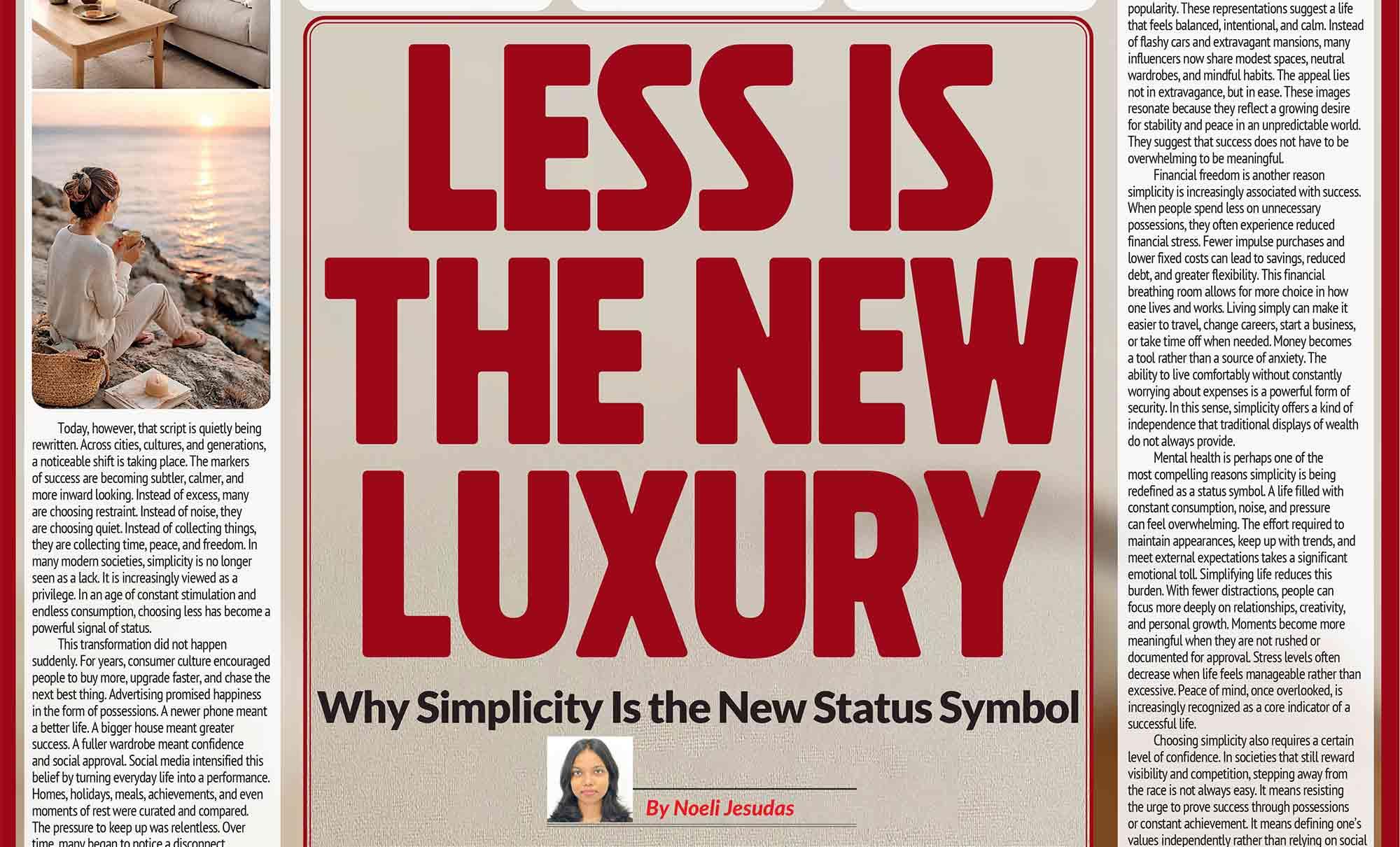
The rise of minimalism has played a significant role in shaping this new understanding of status. Minimalism encourages people to remove what is unnecessary and focus on what truly matters. This applies not only to physical possessions, but also to commitments, expectations, and mental clutter. Homes influenced by minimalist thinking tend to be calmer, cleaner, and more functional. Objects are chosen with care. Spaces are designed to support rest rather than impress. The emotional impact of such environments is profound. Walking into an organized, peaceful space after a long day can feel deeply restorative. Fewer possessions mean fewer things to manage, clean, repair, and replace. This reduction in physical clutter often leads to a reduction in mental stress. Simplicity in surroundings allows the mind to settle. In this way, a calm home becomes a luxury in itself.
Environmental awareness has also pushed simplicity into the spotlight. As the effects of climate change become harder to ignore, many people are reconsidering their consumption habits. Fast fashion, disposable products, and constant technological upgrades are increasingly viewed with skepticism. The environmental cost of overconsumption has forced a broader conversation about responsibility and sustainability. Choosing to buy fewer, better-quality items, repairing rather than replacing, and supporting ethical brands has become part of a modern value system. Living simply is no longer just a personal lifestyle choice. It is also a statement of care for the planet. For many, the ability to live responsibly and consciously has become more meaningful than owning the latest or most expensive product. In this context, restraint signals awareness, and awareness signals status.
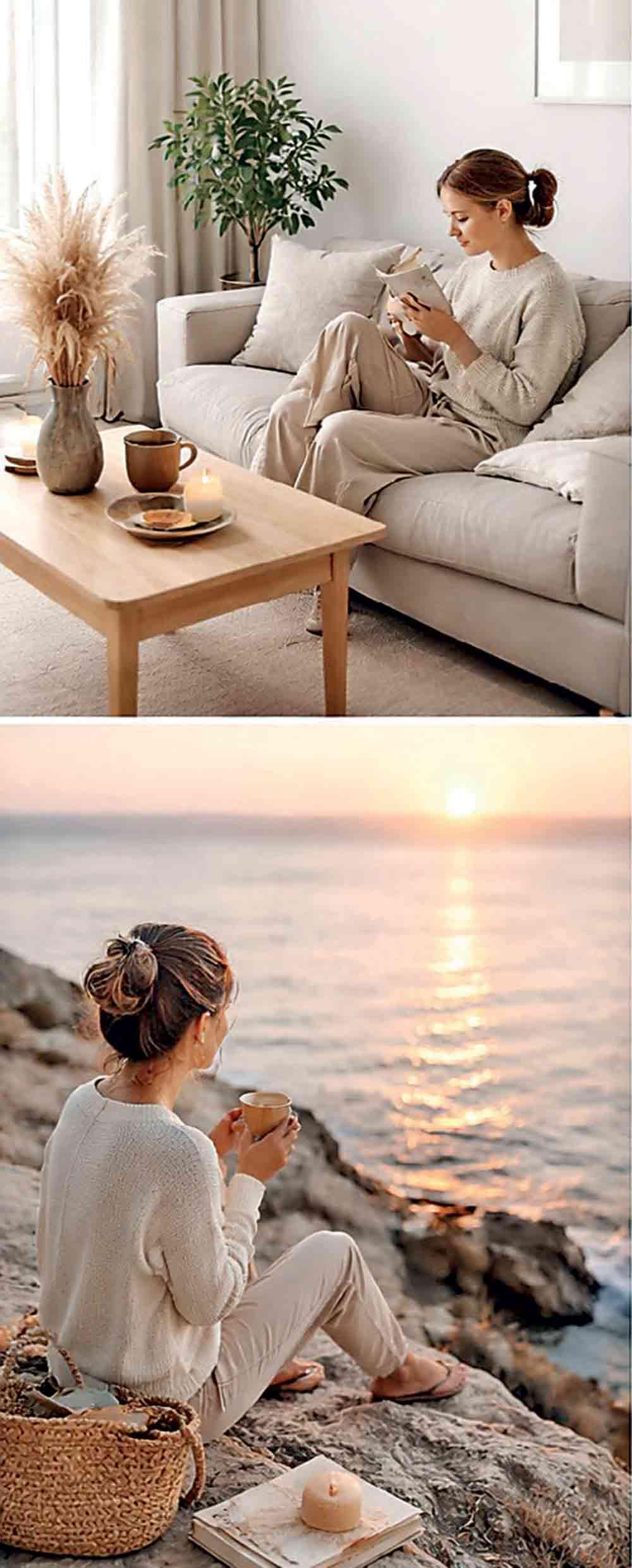
Social media, once a major driver of excess, has surprisingly helped normalize this shift. While it initially promoted aspirational displays of luxury, it now also celebrates slower, simpler ways of living. Images of minimalist homes, quiet morning routines, thoughtfully prepared meals, and unhurried moments have gained popularity. These representations suggest a life that feels balanced, intentional, and calm. Instead of flashy cars and extravagant mansions, many influencers now share modest spaces, neutral wardrobes, and mindful habits. The appeal lies not in extravagance, but in ease. These images resonate because they reflect a growing desire for stability and peace in an unpredictable world. They suggest that success does not have to be overwhelming to be meaningful.
Financial freedom is another reason simplicity is increasingly associated with success. When people spend less on unnecessary possessions, they often experience reduced financial stress. Fewer impulse purchases and lower fixed costs can lead to savings, reduced debt, and greater flexibility. This financial breathing room allows for more choice in how one lives and works. Living simply can make it easier to travel, change careers, start a business, or take time off when needed. Money becomes a tool rather than a source of anxiety. The ability to live comfortably without constantly worrying about expenses is a powerful form of security. In this sense, simplicity offers a kind of independence that traditional displays of wealth do not always provide.
Mental health is perhaps one of the most compelling reasons simplicity is being redefined as a status symbol. A life filled with constant consumption, noise, and pressure can feel overwhelming. The effort required to maintain appearances, keep up with trends, and meet external expectations takes a significant emotional toll. Simplifying life reduces this burden. With fewer distractions, people can focus more deeply on relationships, creativity, and personal growth. Moments become more meaningful when they are not rushed or documented for approval. Stress levels often decrease when life feels manageable rather than excessive. Peace of mind, once overlooked, is increasingly recognized as a core indicator of a successful life.
Choosing simplicity also requires a certain level of confidence. In societies that still reward visibility and competition, stepping away from the race is not always easy. It means resisting the urge to prove success through possessions or constant achievement. It means defining one’s values independently rather than relying on social validation. Those who live simply often appear grounded and self-assured. Their happiness is less dependent on external approval and more rooted in personal satisfaction. This quiet confidence is deeply attractive. It suggests a life lived with purpose rather than pressure. In many ways, it is this inner stability that has become the new marker of success. This shift does not suggest that ambition or wealth are inherently negative. The difference lies in how success is expressed. In the past, success was designed to be noticed. Today, it is becoming more private. Well-being, health, meaningful work, strong relationships, and personal freedom are increasingly valued over public displays of luxury.
The new status symbols are subtle. A flexible schedule. A calm home. A healthy body. A clear mind. Time for loved ones. The freedom to choose how one lives. These are forms of richness that cannot be easily compared or displayed, yet they are deeply felt. In a world driven by constant consumption and competition, simplicity stands out precisely because it resists both. It represents control in a chaotic environment. It offers relief from pressure, debt, and comparison. It allows people to focus on what genuinely enhances their lives rather than what merely signals success to others. Ultimately, simplicity is becoming the new status symbol because it reflects a deeper understanding of what it means to live well. It is not about having less for the sake of it, but about making room for what truly matters. As more people step away from excess and towards intention, the definition of luxury continues to evolve. Perhaps true luxury is no longer about what we own or how busy we appear. Perhaps it lies in how peacefully we live, how freely we choose, and how purposefully we spend our time. In choosing less, many are discovering that they have gained far more than they gave up.