

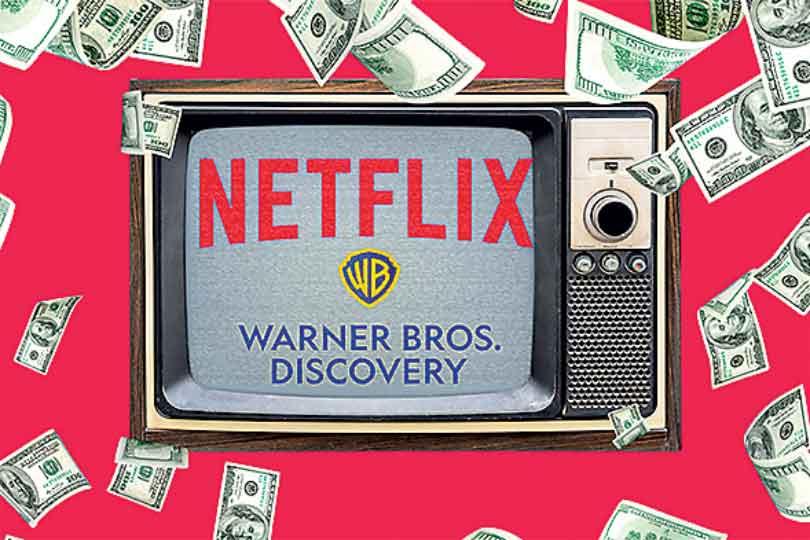
In December 2025 the global entertainment industry was thrown into upheaval when Netflix revealed it had struck a definitive agreement to acquire the film-studio and streaming assets of Warner Bros Discovery (WBD) in a deal valuing those assets at around 82.7 billion US dollars. The acquisition would fold one of Hollywood’s most venerable studios into the world’s largest streaming service. The deal, if approved, promised to reshape not only the business of entertainment but also how stories are created, distributed and consumed across the globe.
Under the announced deal Netflix will acquire WBD’s storied film and television studios, along with its streaming service assets, for roughly 72 billion dollars in equity value. The remainder of the 82.7 billion enterprise value reflects the existing debt on WBD’s books. The plan excludes WBD’s linear television networks such as cable news and lifestyle channels, which are slated to be spun off into a separate publicly traded company expected to launch in 2026, with the working name “Discovery Global.”
From Netflix’s perspective the acquisition represents a defining moment in its transformation from a mail-order DVD service into a global streaming behemoth. For decades Warner Bros has amassed a library of iconic content spanning major film franchises, blockbuster television series and timeless classics. That catalogue includes the globally beloved Wizarding World from the Harry Potter films, the vast DC Comics universe, featuring Batman, Wonder Woman and their many co-starring sagas, as well as high-profile television properties and cinematic works whose intellectual property alone carries enormous weight. Gaining control of these assets would give Netflix not only prestige, but also a level of creative and commercial leverage unmatched by any competitor in the streaming space.
Netflix executives have spoken publicly about their ambition to combine Warner’s rich legacy of storytelling with Netflix’s global reach, data-driven distribution systems and production capacity. Early plans reportedly envision new films, streaming series, international versions of established franchises, immersive experiences and expanded investment in original productions anchored in the Warner catalog. For many viewers these changes could mean easier and broader access to content that once spanned multiple platforms, potentially unified under the Netflix brand.
Industry watchers initially interpreted the announcement as the crowning moment of a dramatic bidding war. Over preceding weeks multiple major players had vied for WBD’s assets. Among them were legacy media giants such as Comcast and Paramount Skydance, the latter a recently formed entity emerging from the combination of a traditional studio and a modern media producer. Many observers expected one of these legacy players to secure a deal more favourable to conventional media models. In the end Netflix emerged as the winner, or so it seemed.
That changed dramatically on Monday December 8, 2025, when Paramount Skydance launched a hostile all-cash bid valued at 108.4 billion dollars for the entirety of Warner Bros Discovery, not just the studios and streaming, but also the cable networks and news channels that Netflix had elected to exclude. Paramount’s bid offers 30 dollars per share in cash, significantly higher than Netflix’s 27.75 dollars per share offer that splits into cash and Netflix stock.
The new proposal values WBD at about 108.4 billion dollars, including debt, which represents a substantial premium over both the pre-deal stock valuation and Netflix’s enterprise valuation.
Paramount’s campaign is both bold and provocative. Rather than negotiating through WBD’s board, which had already accepted the Netflix deal, Paramount is appealing directly to shareholders in an effort to override the board’s decision. The company argues that its all-cash offer provides greater certainty, higher immediate return, and a simpler regulatory path than Netflix’s mixed deal. Paramount has framed its bid as more beneficial for shareholders, for the creative community, for movie theatres, and for consumers. Paramount CEO David Ellison has described the proposal as providing “higher headline value, increased certainty, greater regulatory certainty, and a pro-Hollywood, pro-consumer, pro-competition future.”
According to regulatory filings, the financing for Paramount’s offer is backed by the Ellison family, private equity investors, and a number of global investment funds. The all-cash structure, they argue, reduces the complexity that stock-based deals carry and lowers the risk of volatile share pricing affecting the outcome. Paramount has also increased the breakup fee, the amount payable if the deal fails, reportedly making clear its confidence the acquisition can clear regulatory scrutiny.
With this new bid, the takeover battle is far from over. WBD’s board said it will review Paramount’s proposal in accordance with its fiduciary duties. For now, the board has neither endorsed nor rejected the offer, and it advised shareholders to take no action, signalling that the Netflix agreement remains preferred, at least for the moment. But the board’s hands may be tied if shareholders voice support for Paramount’s higher-priced, cash-based proposal.
For Netflix the challenge is now two-fold. The company must persuade regulators in the United States and abroad to approve what would be one of the deepest and most sweeping consolidations in media history. Critics have already raised concerns that combining Netflix’s streaming platform with Warner’s vast content library could reduce competition and diversity in the entertainment market. The addition of Paramount’s challenge adds uncertainty: Netflix may need to increase its bid, redraw its financing, or renegotiate terms to keep the deal alive.
For the broader industry the stakes are enormous. If Paramount’s bid succeeds, the media landscape could coalesce around a handful of vertically integrated super-studios controlling production, streaming, cable networks, and news outlets. Paramount argues that its offer would actually enhance competition by allowing a company other than Netflix to compete on a similar scale, combining heritage media assets with modern infrastructure. Paramount claims that preserving Warner’s full portfolio under one roof, studios, streaming, cable networks, could strengthen theatrical releases, support content diversity, and sustain legacy media operations like cable news and sports broadcasting.
But not everyone agrees. Critics argue that concentration of so much power in one company raises serious regulatory and political questions. In Washington some lawmakers have already expressed alarm. A transaction bringing together major entertainment content, cable news networks and distribution channels under one corporate umbrella could represent “one company controlling almost everything Americans watch on TV,” as one senator described it. That taps into long-standing concerns about media plurality, diversity of viewpoints, labour conditions, and fair competition.
In addition to political scrutiny, there is opposition from workers and creators. For example, the writers’ union Writers Guild of America (WGA) has publicly warned that such consolidation often harms creative competition and reduces job opportunities. The union argues that repeated mergers in the media industry have historically led to cutbacks, diminished bargaining power for creators, and reduced plurality of voices. The WGA says it will lobby regulators to block any merger involving Paramount and Warner Bros Discovery, or other consolidations that combine multiple major media players.
Exhibitors and cinema-owners are also watching carefully. Some fear that a merged mega-studio might deprioritize theatrical release windows altogether in favour of streaming launches, as has happened with some recent releases under streaming-first strategies. If that trend intensifies, it could further destabilize cinemas, many of which are still recovering from years of disruption caused by changing consumer habits, global economic pressures, and pandemic-era shutdowns.
At the same time however, Paramount insists that its proposal would be “pro-Hollywood,” promising to maintain theatrical windows, support movie theatres, and combine buildouts of streaming infrastructure with legacy distribution channels. Paramount argues that it is uniquely positioned to deliver on both fronts, leveraging Warner’s library and Paramount’s cable network infrastructure, with the financial backing to invest in content production, marketing, and global distribution.
Shareholders now face a difficult calculus. On one hand there is the deal already agreed with Netflix: a lower per-share price, but a plan that avoids the headache and regulatory complexity of cable networks and news outlets. On the other hand, Paramount offers more money in cash per share and a comprehensive acquisition that includes all assets. The risk however is that regulatory authorities, in the US, EU and other jurisdictions, might block or heavily condition the deal, delaying payout or requiring structural divestitures.
Regulators have already signalled they plan to scrutinize the Netflix-WBD agreement carefully. Officials in the United States and around the world have growing concerns about media consolidation. The sheer scale of Paramount’s bid only intensifies those worries. Among the questions regulators are likely to ask: would this deal significantly reduce competition in entertainment, streaming, cable networks, and news? Would it limit consumer choice? Would it give one company undue influence over what content gets produced, distributed or promoted? Would it disadvantage independent creators and smaller studios?
From a strategic perspective Paramount has framed its bid not simply as a takeover but as a vision for a different type of media conglomerate, one that retains legacy media operations while updating them for the streaming age. Paramount markets this idea as the best way forward for Hollywood: a comprehensive, integrated company capable of producing, distributing and marketing content across multiple platforms, streaming, cable, theatrical release, global broadcast, without fragmenting assets between separate owners.
In a broader sense the fallout from this battle could define the future of Hollywood and global entertainment. If the Netflix deal proceeds, we may see the rise of an all-powerful streaming studio owning the biggest library of content and global reach. If Paramount wins, the industry might move into a different paradigm: vertically integrated mega-studios that combine streaming, cable, news, theatrical distribution and global media reach in one. Either way the consolidation undermines the media ecosystem as it existed just a few months ago.
For audiences the coming years will decide whether this consolidation leads to a renaissance, with more resources, bigger budgets, broader distribution and enhanced global storytelling, or a contraction; fewer independent voices, narrower creative risks, and content shaped by corporate algorithms and global strategies rather than local creators, cultural diversity, or experimental art.
Within the world of creators, executives and regulators the questions now multiply. Will regulators block the deal, or force structural changes? Will theatres survive in a world increasingly dominated by streaming and integrated media conglomerates? Will creators still find room for original voices, or will everything revolve around a handful of huge franchises owned by a few companies?
What is undeniable is that the entertainment business has reached a turning point. Streaming companies are no longer mere disruptors. They have become buyers of legacy studios. Legacy studios themselves, once the gatekeepers of film and television, can now be treated as acquisition assets. The battle for Warner Bros Discovery may well become the defining fight for the future of media.
As Paramount presses on with its aggressive all-cash takeover bid, and Netflix braces for a potential bidding war and regulatory challenges, the world waits to see which version of the future will emerge; a streaming-driven empire under Netflix, or a reintegrated legacy media titan under Paramount. Either outcome would mark a wholesale transformation of Hollywood, distribution and the very nature of storytelling in the decades to come.