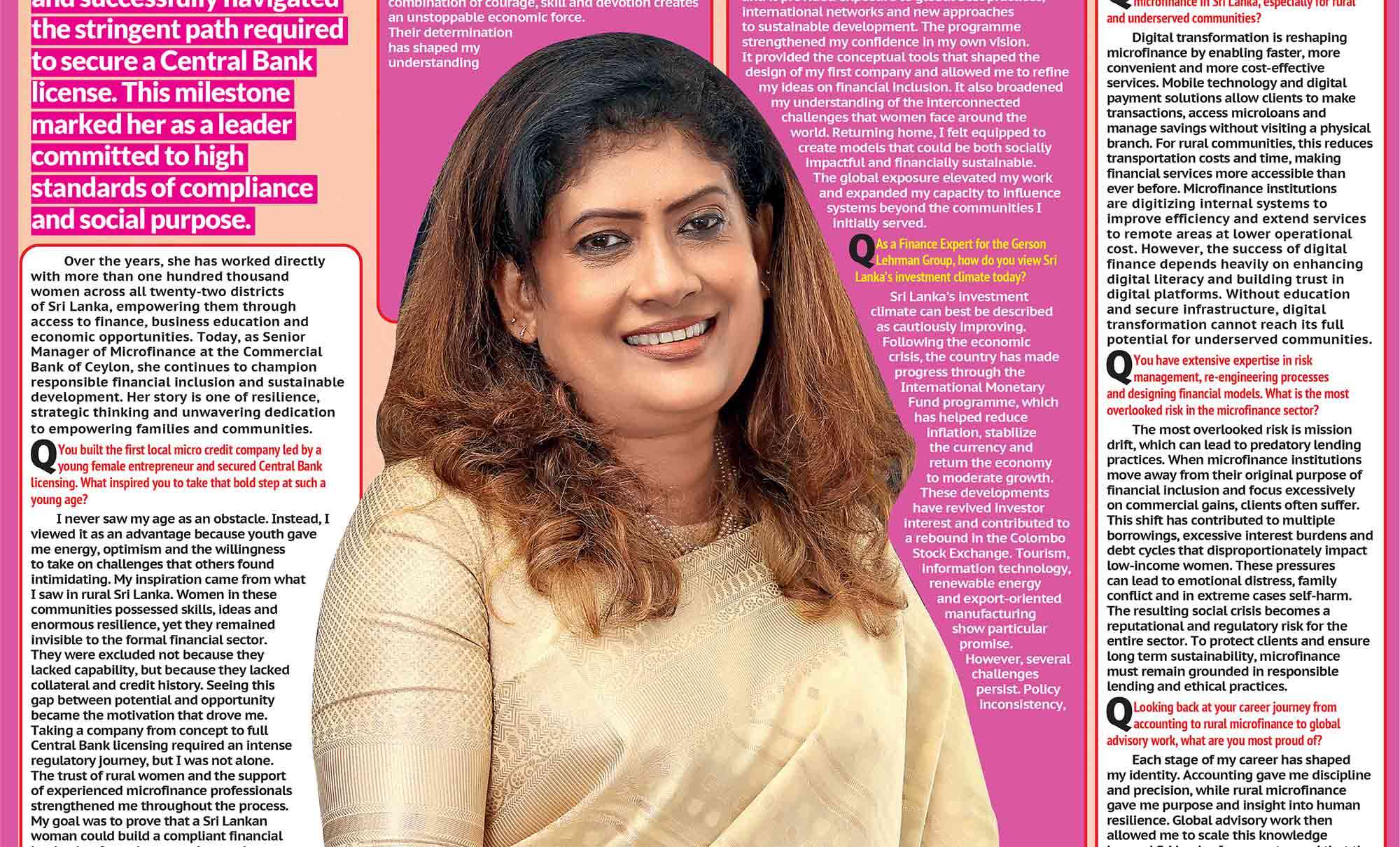

 Renuka Rathnahewage stands out as one of Sri Lanka’s most influential voices in microfinance, combining regulatory knowledge, entrepreneurial courage and deep community insight. Her journey began with an extraordinary achievement for someone so young. She founded the first local micro credit company established and led by a young female entrepreneur and successfully navigated the stringent path required to secure a Central Bank license. This milestone marked her as a leader committed to high standards of compliance and social purpose. +
Over the years, she has worked directly with more than one hundred thousand women across all twenty-two districts of Sri Lanka, empowering them through access to finance, business education and economic opportunities. Today, as Senior Manager of Microfinance at the Commercial Bank of Ceylon, she continues to champion responsible financial inclusion and sustainable development. Her story is one of resilience, strategic thinking and unwavering dedication to empowering families and communities.
Q You built the first local micro credit company led by a young female entrepreneur and secured Central Bank licensing. What inspired you to take that bold step at such a young age?
I never saw my age as an obstacle. Instead, I viewed it as an advantage because youth gave me energy, optimism and the willingness to take on challenges that others found intimidating. My inspiration came from what I saw in rural Sri Lanka. Women in these communities possessed skills, ideas and enormous resilience, yet they remained invisible to the formal financial sector. They were excluded not because they lacked capability, but because they lacked collateral and credit history. Seeing this gap between potential and opportunity became the motivation that drove me. Taking a company from concept to full Central Bank licensing required an intense regulatory journey, but I was not alone. The trust of rural women and the support of experienced microfinance professionals strengthened me throughout the process. My goal was to prove that a Sri Lankan woman could build a compliant financial institution from the ground up and serve those who had long been overlooked.
Q You have led two financial institutions as CEO and founding director. What leadership philosophies or practices define you today?
My leadership philosophy is grounded in strategic foresight and human centric execution. I believe that a leader must create clarity through planning while remaining adaptable to change. Structural improvements, regular updates to policies and clear, data driven decision making are essential components of my leadership. I emphasize teamwork and cultivate an environment where people feel valued and supported. Empathy is not separate from leadership. It is part of building commitment and integrity within a team. In practice, I remain closely connected to daily operations to ensure realistic and grounded decision making. Financial sustainability is another cornerstone of my approach. I work with banks, donors and funding agencies through long term strategies and prudent cost management. Internally, monitoring systems and accountability frameworks help me present well researched proposals to boards, encouraging strategic improvements backed by evidence rather than intuition.
Q Turning around loss making or early-stage organizations is not easy. What is your approach to transformation and rapid growth?
My approach begins with absolute clarity of strategy. A strong, actionable plan must be developed, endorsed by the board and communicated with precision across the organization. This plan should define the market opportunity and capture the unique value proposition that differentiates the organization. The next stage involves operational restructuring and building lean systems. This includes reducing unnecessary costs, streamlining procedures and setting clear performance indicators that produce quick and measurable results. The third stage focuses on securing financial resources. Whether through banks, donors or grant funding, investors must see a credible path to profitability. Without financial backing, even the most visionary plan cannot achieve scale. Finally, transformation relies on the ability to manage people effectively. Teams must understand their role in the organizational mission. Continuous communication, capacity building and a performance-oriented culture ensure that rapid growth can be sustained responsibly and ethically.
Q You have worked with over one hundred thousand women across all twenty-two districts. What is the most powerful lesson you have learned from rural women entrepreneurs?
The most powerful lesson I have learned is the extraordinary resilience and sense of purpose that rural women carry.
These women manage businesses while also fulfilling household responsibilities, caregiving duties and social expectations that often place immense pressure on them. Despite these challenges, they continue to build enterprises because they see their work as part of safeguarding their families. Their businesses are not simply income generating activities. They are expressions of commitment to their children’s wellbeing and their families’ future. This combination of courage, skill and devotion creates an unstoppable economic force. Their determination has shaped my understanding of development. When women are given access to financial tools and knowledge, they multiply that investment through discipline, creativity and an unshakeable desire to uplift their families.

Q You were awarded a United States Government Scholarship under the International Visitor Leadership Program. How did that global exposure influence your work back home?
The International Visitor Leadership Program was a transformative experience and a major turning point in my career. It was awarded in recognition of my work in empowering rural women, and it provided exposure to global best practices, international networks and new approaches to sustainable development. The programme strengthened my confidence in my own vision. It provided the conceptual tools that shaped the design of my first company and allowed me to refine my ideas on financial inclusion. It also broadened my understanding of the interconnected challenges that women face around the world. Returning home, I felt equipped to create models that could be both socially impactful and financially sustainable. The global exposure elevated my work and expanded my capacity to influence systems beyond the communities I initially served.
Q As a Finance Expert for the Gerson Lehrman Group, how do you view Sri Lanka’s investment climate today?
Sri Lanka’s investment climate can best be described as cautiously improving. Following the economic crisis, the country has made progress through the International Monetary Fund programme, which has helped reduce inflation, stabilize the currency and return the economy to moderate growth. These developments have revived investor interest and contributed to a rebound in the Colombo Stock Exchange. Tourism, information technology, renewable energy and export-oriented manufacturing show particular promise. However, several challenges persist. Policy inconsistency, regulatory unpredictability and bureaucratic delays continue to discourage large scale investors. The completion of debt restructuring remains critical. Social vulnerabilities, including rising poverty, pose medium term risks. Overall, Sri Lanka presents opportunities but requires investors who have experience managing risk and who are willing to align with sectors that can deliver long term sustainability.
Q How is digital transformation reshaping microfinance in Sri Lanka, especially for rural and underserved communities?
Digital transformation is reshaping microfinance by enabling faster, more convenient and more cost-effective services. Mobile technology and digital payment solutions allow clients to make transactions, access microloans and manage savings without visiting a physical branch. For rural communities, this reduces transportation costs and time, making financial services more accessible than ever before. Microfinance institutions are digitizing internal systems to improve efficiency and extend services to remote areas at lower operational cost. However, the success of digital finance depends heavily on enhancing digital literacy and building trust in digital platforms. Without education and secure infrastructure, digital transformation cannot reach its full potential for underserved communities.
Q You have extensive expertise in risk management, re-engineering processes and designing financial models. What is the most overlooked risk in the microfinance sector?
The most overlooked risk is mission drift, which can lead to predatory lending practices. When microfinance institutions move away from their original purpose of financial inclusion and focus excessively on commercial gains, clients often suffer. This shift has contributed to multiple borrowings, excessive interest burdens and debt cycles that disproportionately impact low-income women. These pressures can lead to emotional distress, family conflict and in extreme cases self-harm. The resulting social crisis becomes a reputational and regulatory risk for the entire sector. To protect clients and ensure long term sustainability, microfinance must remain grounded in responsible lending and ethical practices.
Q Looking back at your career journey from accounting to rural microfinance to global advisory work, what are you most proud of?
Each stage of my career has shaped my identity. Accounting gave me discipline and precision, while rural microfinance gave me purpose and insight into human resilience. Global advisory work then allowed me to scale this knowledge beyond Sri Lanka. I am most proud that the understanding I gained at the grassroots level now contributes to improving the lives of women globally. Working with diverse cultures and communities has enriched my perspective and has allowed me to support mothers and women facing varied but interconnected challenges. This ability to influence policy and strategy at an international level affirms the value of every step in my journey.
Q As a wife and mother, how do you see the link between financial inclusion and building a stable and empowered family life?
Financial inclusion provides the foundation for family stability, resilience and growth. When families have access to bank accounts, savings tools, credit and insurance, they are better equipped to manage unexpected challenges such as illness or income loss. For mothers, financial inclusion is particularly empowering. Having control over finances allows women to contribute economically, make independent decisions and plan for their children’s future. This independence builds confidence and sets an example of responsibility and strength for the next generation. Financial inclusion transforms a family’s outlook from daily survival to long term planning, enabling investments in education, housing and business opportunities. In my view, empowering women financially is one of the most effective ways to build strong and stable families.