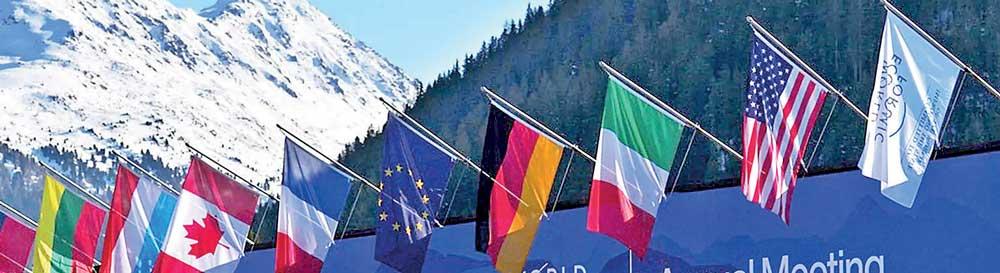
Snow fell softly on Davos as motorcades wound through narrow Alpine streets and the world’s most powerful people gathered once again under the banner of dialogue. The World Economic Forum in Two Thousand Twenty-Six was billed as a moment for calm conversation in an anxious world. Instead, it became a vivid showcase of global tension personality politics and a growing divide between those who believe in rules and those who believe in leverage. From the main congress hall to side rooms thick with private negotiations the mood was unmistakably charged. This year Davos felt less like a conference and more like a stage. Leaders arrived acutely aware that every word every gesture and even every accessory would be scrutinised. Nothing illustrated that better than the unexpected symbol that dominated headlines and social media feeds alike: the aviator sunglasses worn by President Emmanuel Macron. What might once have passed unnoticed became a shorthand for defiance irony and the personalisation of global power. The meeting unfolded against a backdrop of fragile alliances rising protectionism and deep unease about the future of multilateral cooperation. The conversations in Davos revealed not just policy disagreements but competing philosophies of leadership and legitimacy.
 President Trump Takes the Stage
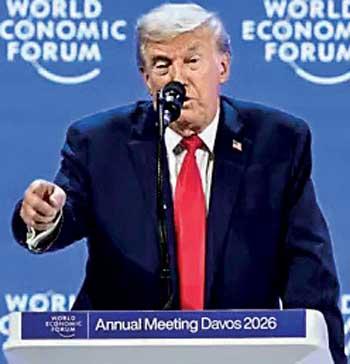
Few leaders commanded as much attention in Davos as President Donald Trump. His arrival was anticipated with a mix of fascination and apprehension and his speeches did not disappoint those expecting disruption. Trump used his time in Davos to restate his worldview in characteristically blunt terms. In his keynote address he declared that the United States had entered what he described as a period of renewed strength and leverage. “The world is richer safer and more stable when America is strong and unafraid to use its power,” he told the audience. The line was widely quoted and quickly interpreted as a justification for the confrontational tone that has defined his foreign policy.
The most controversial moment came when President Trump spoke about Greenland. Revisiting a subject that has already strained relations with European allies he said plainly “Greenland is our territory.” Gasps rippled through the hall. Though he later added “We will not use force to get it,” the damage was done. Diplomats present described the remark as deliberately provocative and emblematic of a shift away from traditional alliance diplomacy.
President Trump also unveiled what he called a Board of Peace a new initiative that he claimed would resolve conflicts faster than existing institutions. “We are building something new because the old systems are too slow too political and too weak,” he said. “Peace needs strength not endless meetings.” Critics immediately questioned whether the proposal undermined the United Nations while supporters praised it as bold and pragmatic.
Yet it was not only policy that defined President Trump’s Davos moment. In a remark that seemed half joking and half pointed he referenced President Macron directly. “I watched Emmanuel yesterday. I like him. I really do. And I have to say those sunglasses were something else,” Trump said smiling. The comment drew laughter but also highlighted how personal the summit had become.
 President Macron and the Politics of Style
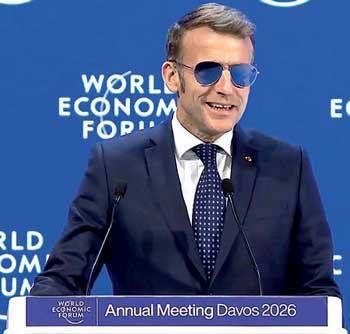
If President Trump’s presence in Davos was loud and unapologetic President Macron’s was cool controlled and visually striking. Appearing on stage wearing reflective aviator sunglasses Macron instantly became the most photographed leader of the week. The reason was medical rather than theatrical, but the symbolism was irresistible.
Social media dubbed him Europe’s Maverick and the images spread far beyond the conference halls. President Macron later explained that he was protecting his eyes after a minor medical issue, but the moment had already taken on a life of its own. In an era when politics is increasingly visual the sunglasses became shorthand for resilience and resistance.
President Macron’s speech matched the symbolism. He delivered one of the most forceful defences of international law heard at Davos in recent years. “We are entering a world without rules,” he warned. “A world where international law is trampled and where the strongest decide for the rest.” The quote dominated headlines across Europe.
Without naming President Trump directly President Macron addressed the issue of coercion and territorial pressure. “Europe will not give in to intimidation,” he said. “Sovereignty is not for sale, and it is not negotiable.” The line was met with prolonged applause and quickly became a rallying cry among European leaders.
Later when asked about the attention paid to his sunglasses President Macron smiled briefly before returning to substance. “What matters is not how we look but what we defend,” he said. “And what we defend are rules cooperation and dignity between nations.” It was a pointed contrast to the more performative style on display elsewhere.
A Fracturing Western Consensus
Beyond the headline moments the conversations in Davos revealed a deeper anxiety about the future of the Western alliance. For decades Davos has functioned as an informal gathering place for like-minded leaders committed to open markets and shared norms. In Two Thousand Twenty-Six that consensus appeared visibly strained.
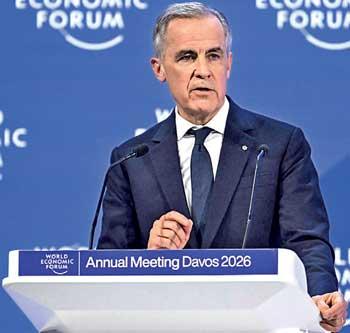
On stage the warnings were more explicit. Prime Minister Mark Carney delivered a sober address that contrasted sharply with President Trump’s rhetoric. “The rules based international order is fading,” Prime Minister Carney said. “If we do not actively defend it, we should not be surprised when it disappears.” His speech was praised for its clarity and restraint.
Prime Minister Carney urged middle powers to cooperate more closely rather than waiting for direction from larger states. “No single country can manage today’s risks alone,” he said. “Our strength lies in coordination not confrontation.”
 Technology Power and Unease
While geopolitics dominated the headlines technology debates provided a parallel narrative of disruption and uncertainty. Artificial intelligence featured prominently in panels and private discussions with sharply diverging views. One of the most quoted interventions came from a Jamie Dimon, CEO, JPMorgan Chase, who warned of social instability if AI deployment moved too quickly. “If we are not careful we will automate inequality,” he said. “Technology does not guarantee progress. Choices do.” Others argued that slowing innovation would leave societies unprepared. The debate reflected a broader tension between optimism and caution that ran through the entire forum. President Macron himself returned to this theme arguing that Europe must invest aggressively while maintaining ethical guardrails. “We cannot be naive, and we cannot be afraid,” he said. “Leadership means shaping technology not fleeing from it.”
Theatre of Davos
What set Davos Two Thousand Twenty-Six apart was not simply the content of the speeches but the performative nature of leadership on display. President Trump’s confident provocations President Macron’s visual symbolism and the carefully calibrated interventions of others all underscored a reality of modern politics: perception is power. The sunglasses episode captured this perfectly. A minor personal detail became a global talking point because it fit a narrative of style defiance and personality. In an age of instant commentary leaders are no longer judged solely on policy but on image tone and symbolism. President Trump seemed keenly aware of this dynamic. His asides jokes and direct language were designed to dominate attention. President Macron countered with restraint and symbolism. Both approaches worked in different ways.
Europe Closes Ranks
The European response to Trump’s remarks on Greenland and trade was unusually unified. Leaders from across the continent echoed President Macron’s insistence on sovereignty and legal norms.
The President of the European Commission told delegates that territorial integrity was “non-negotiable” and warned against a return to spheres of influence. Though her tone was diplomatic the message was unmistakable. In private meetings, sources confirmed to international media, European officials discussed accelerating defence cooperation and reducing strategic dependence. Davos became not just a forum for discussion but a catalyst for quiet recalibration.
What Davos Revealed
As the snow continued to fall, and delegations departed Davos the central question lingered. Is the world moving toward a future of fragmented power and transactional relationships or can cooperation be renewed on new terms. Davos did not provide a clear answer, but it did expose the stakes. President Trump’s declaration that “peace needs strength” and President Macron’s warning of a “world without rules” represent two competing visions. One prioritises leverage and immediacy. The other prioritises law and continuity. For business leaders and smaller nations, the uncertainty is unsettling. Many left Davos acknowledging that adaptability rather than predictability may define the years ahead.
A Moment That Will Be Remembered
In years to come Davos Two Thousand Twenty-Six is likely to be remembered not for a single agreement or breakthrough but for its symbolism. It was the year when disagreements once confined to private rooms moved openly onto the main stage.
It was the year when alliances were tested in public and when a pair of sunglasses came to represent a broader struggle over tone authority and the future of leadership. As President Macron himself remarked in a quieter moment away from the cameras “History is shaped not only by decisions but by moments when we reveal who we are.” In Davos this year the world saw that revelation with unusual clarity.