 In the annals of cricketing history, there are moments when a nation’s sporting pride doesn’t simply fade. It crumbles, brick by brick, match by match, until what was once a fortress becomes a ruin. We are witnessing such a moment now with Sri Lankan cricket, and the question haunting every tea shop, every office corridor, every living room across this island is no longer “Can we win?” but rather “Can we survive?” The alarm bells aren’t ringing anymore.
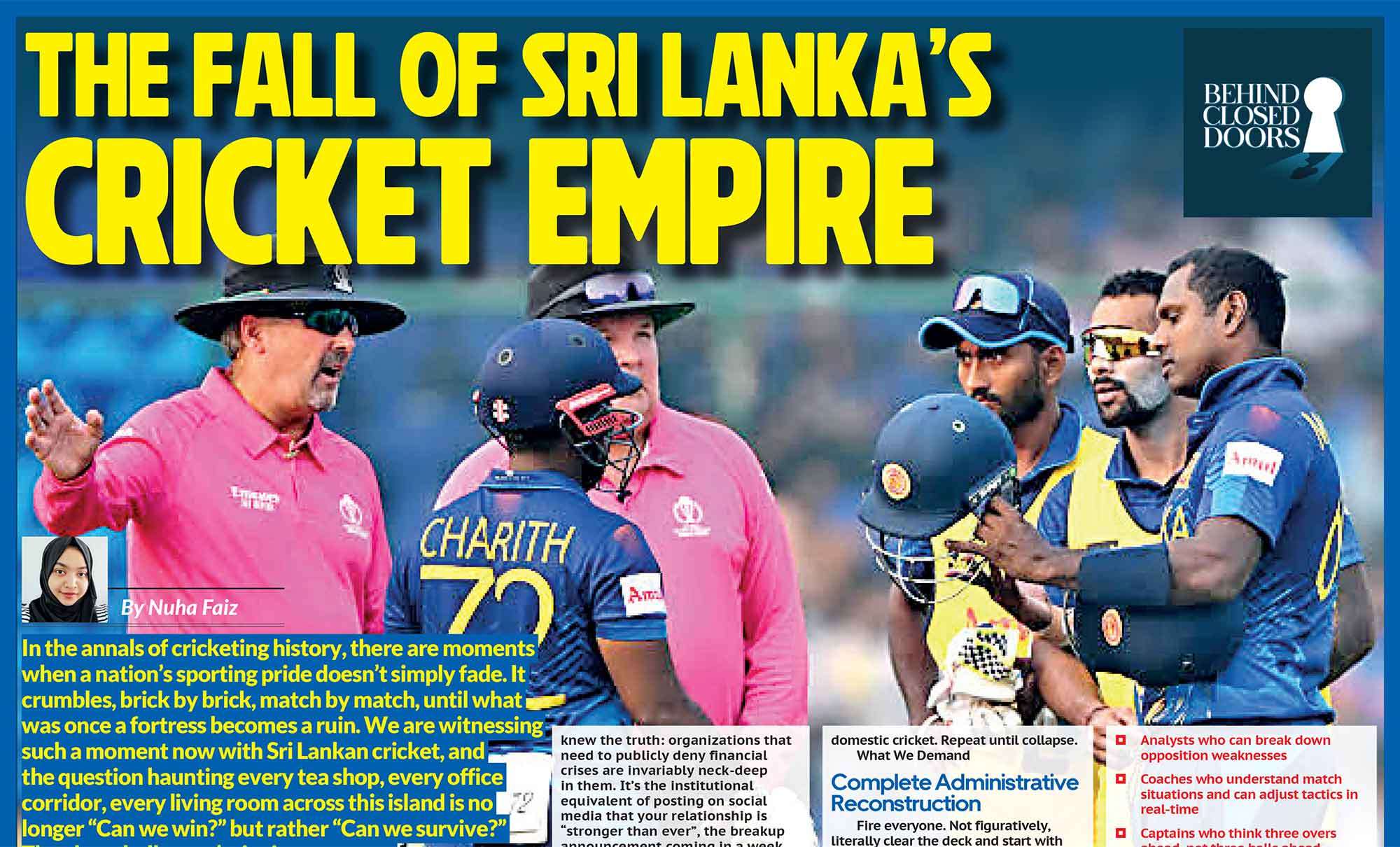
They’ve been smashed to pieces. What we’re hearing now is the death rattle. England’s recent conquest of our shores wasn’t merely a series loss, it was a public vivisection of everything that has gone wrong with Sri Lankan cricket over the past decade. The 2-1 ODI series defeat at home, our first since India’s 2021 victory, wasn’t an anomaly. It was the symptom of a disease that has metastasized throughout our cricketing body. When Harry Brook, a batsman whose off-field conduct is currently under scrutiny in New Zealand, can walk into Pallakelle and butcher our bowling attack for 136 runs off 65 balls, we’re not watching cricket. We’re watching a demolition.
The Systematic Collapse
Sri Lanka’s Test schedule for 2026 comprises exactly six matches. SIX. In an entire year. For context, this is fewer Tests than we played in 1982, when we were barely four years into our Test cricket journey. We had only four Test matches in 2025. This isn’t a schedule, it’s an afterthought. It’s the kind of fixture list you give to an Associate nation still finding its feet, not to a country that has won a World Cup, produced legends like Muralidharan and Sangakkara, and once made visiting teams genuinely fear the prospect of touring our grounds. When England’s last five overs yielded 88 runs in that third ODI with 88 runs that turned a manageable chase into a grotesque massacre, it wasn’t just poor bowling. It was emblematic of a deeper rot: the complete absence of match awareness, tactical acumen, and mental fortitude that once defined Sri Lankan cricket. Our bowlers didn’t just lose the plot; they never had it to begin with. The T20 series painted an equally grim picture. Dasun Shanaka’s team posted 189 runs and still found a way to lose. How is this bad luck?
When Cricket Becomes Charity
But let’s pull back the curtain on the real issue which is money. Or rather, the catastrophic lack of it. The Pakistan-India boycott saga surrounding the T20 World Cup has exposed Sri Lanka Cricket’s (SLC) Achilles heel with brutal clarity. Pakistan’s refusal to play India in Colombo on February 15, a match that was supposed to be the financial cornerstone of our World Cup hosting, has sent SLC into a tailspin. Why? Because that single match represented a revenue stream so substantial that its absence threatened the viability of hosting the tournament at all.
Think about what this reveal. Sri Lanka has positioned itself as a cricketing nation so dependent on other countries’ bilateral arrangements that we’re essentially begging Pakistan to reconsider, not for the love of cricket, but because we’ve budgeted our entire hosting operation around revenue we don’t control. SLC President Shammi Silva’s phone calls to PCB Chairman Mohsin Naqvi aren’t diplomatic courtesy, they’re financial desperation dressed up as sporting cooperation. When you’re co-hosting a World Cup but sweating over whether one match will happen because your entire financial model depends on it, you’re not a cricket board. You’re a supplicant. And the truly bitter pill is, despite being one of the BCCI’s most loyal supporters in the ICC, voting their way, supporting their financial structures, playing ball when called upon, we’ve received what in return? A Test schedule so anaemic it makes our doctors concerned. A financial dependency so acute that we can’t afford to invest in grassroots cricket because we need every rupee from international fixtures just to keep the lights on.
The ICC, theoretically the guardian of cricket’s global health, has shown us exactly where we stand. When Bangladesh gets entirely frozen out of the World Cup, it should terrify every mid-tier nation. If the ICC is willing to sideline a Full Member nation with Bangladesh’s enormous cricket-loving population, what’s to stop them from squeezing Sri Lanka even harder? We’re in purgatory: not rich enough to have leverage, not poor enough to generate sympathy, not powerful enough to demand better treatment.
The Institutional Rot
In Chinese martial arts novels, there’s a recurring theme: the most powerful sects fall not to external enemies but to internal decay. Corruption, power struggles, and the prioritization of politics over principle hollow out institutions from within until they collapse under their own weight. Sri Lankan cricket is living that narrative.
When SLC issued a statement in August denying they were in financial crisis, everyone who’s followed this sport long enough knew the truth: organizations that need to publicly deny financial crises are invariably neck-deep in them. It’s the institutional equivalent of posting on social media that your relationship is “stronger than ever”, the breakup announcement coming in a week. The truth is stark: SLC cannot afford to properly invest in grassroots cricket because international fixtures barely generate enough revenue to sustain current operations. We can’t secure enough international fixtures because India, which generates approximately 70% of global cricket revenue, has no financial incentive to play us regularly. And the ICC won’t intervene because keeping India happy takes precedence over protecting smaller boards.
This is the vicious cycle devouring Sri Lankan cricket: poverty breeding irrelevance breeding further poverty. But where it gets truly frustrating is that this isn’t inevitable. It’s the result of specific choices made by specific people who’ve prioritized their own positions over the sport’s health. SLC’s administration has been playing musical chairs while the ship sinks. Cosmetic reshuffles, temporary fixes, and politically connected appointments have replaced genuine strategic planning.
When your selectors change more often than your opening partnerships, when your coaches get fired before they can implement a single long-term vision, when your board meetings are more about securing votes than securing victories, you’re not managing a cricket board. You’re running a patronage network.
The Grassroots Graveyard
Being a domestic cricketer in Sri Lanka in 2026 is not a career, it’s a gamble with terrible odds. Our first-class competitions, which should be the breeding ground for future Test champions, are treated as afterthoughts. The prize money is laughable, the facilities are often substandard, the coaching is inconsistent, and the pathway to the national team is so opaque that talent regularly gets overlooked for connections. Is it any wonder that when our best young players get offers from franchise T20 leagues overseas, they jump at the chance? Not because they don’t love representing Sri Lanka, but because they need to eat. Because they have families to support. Because playing domestic cricket in Sri Lanka pays so poorly that overseas franchise cricket isn’t just an opportunity, it’s a lifeline. We’re bleeding coaching talent too. Why would a top-tier coach accept a Sri Lankan contract when they can earn multiples of that salary in T20 leagues elsewhere? The answer is: they wouldn’t, and they don’t. This creates a doom loop: our domestic cricket gets weaker because it can’t retain or attract quality. Our national team gets weaker because the domestic pipeline produces underprepared players. Our results deteriorate, revenue decreases, and we have even less to invest in domestic cricket. Repeat until collapse. What We Demand
Complete Administrative Reconstruction
Fire everyone. Not figuratively, literally clear the deck and start with competency-based appointments. Bring in sports management professionals who understand modern cricket economics. Hire administrators who can negotiate advantageous deals. Install selectors who prioritize performance over politics. Create transparency requirements: budgets must be public, selection criteria must be explicit, performance metrics must be measurable. End the culture of opacity and unaccountability that has enabled this rot.
Massive Domestic Cricket Investment
Make first-class cricket in Sri Lanka a viable career path. This means:
- Competitive salaries that allow domestic cricketers to focus on their sport
- Professional-standard facilities across all venues
- Qualified coaching at every level
- Performance-based pathways to the national team that are transparent and meritocratic
The money exists, it’s currently being wasted on administrative bloat and questionable expenditures.
Strategic Coalition Building
Stop being everyone’s friend and start building alliances that serve our interests. Form a coalition with New Zealand, South Africa, West Indies, Pakistan, Bangladesh, nations that share our predicament. Collectively push for:
- Fairer revenue distribution models in the ICC
- Guaranteed minimum Test and ODI fixtures annually
- Protection against scheduling that favours the Big Three
- Investment in cricket infrastructure globally, not just in wealthy nations
Youth Development as Non-Negotiable Priority
Identify talent at school level and provide proper support. Create scholarship programs. Build academies that don’t just teach cricket skills but develop cricket intelligence. Invest in sports science, nutrition, psychology, all the infrastructure that modern athletes require. This is a 10–15-year project. It won’t show results tomorrow. But without it, we have no tomorrow.
Tactical and Technical Revolution
Our coaching needs to evolve beyond “hit the ball hard” and “bowl line and length.” Modern cricket is data-driven, tactically sophisticated, and strategically complex. We need:
- Analysts who can break down opposition weaknesses
- Coaches who understand match situations and can adjust tactics in real-time
- Captains who think three overs ahead, not three balls ahead
- A playing philosophy that’s consistent and builds on our strengths
Financial Sustainability Through Diversification
We cannot remain dependent on international fixtures as our primary revenue source. We need:
- Vibrant domestic T20 league that generates broadcast revenue
- Better marketing and merchandising of Sri Lankan cricket
- Corporate partnerships and sponsorships
- Stadium experience improvements to drive ticket sales
- Digital content creation to engage younger fans
Performance Accountability at Every Level
Set clear, measurable targets for the national team, coaching staff, selectors, and administrators. If targets aren’t met, there are consequences. Not empty press releases, actual consequences. Players, coaches, administrators, everyone is accountable.
The Soul of a Nation
There’s a concept called “the heart of martial arts”, the fundamental spirit and principle that should guide all practitioners. Lose that heart, and all the techniques in the world become empty movements. Cricket is woven into Sri Lanka’s social fabric in ways outsiders struggle to comprehend. It’s not just a sport, it’s a unifying force in a country often divided by ethnicity, religion, and politics. It’s a source of national pride for a small island nation competing on the global stage. It’s a dream for countless children who practice with makeshift bats in village squares, imagining themselves as the next Murali, the next Sanga. We’re not just losing matches. We’re losing that soul, that heart. The question is simple and devastating: how much longer can we pretend this is sustainable? The players we send onto the field aren’t the problem, they’re the victims. The problem is the system: corrupt, incompetent, short-sighted, and sustained by people who benefit from its dysfunction. We have the talent. We have the passion. We have a cricket culture. What we lack is the leadership, the structures, and the will to demand better. This is our crossroads moment. This is where we decide whether Sri Lankan cricket dies a slow death through neglect and incompetence, or whether we fight for its resurrection. The choice is ours. The clock is ticking. And history will judge us not by our words, but by our actions.