Stephanie Siriwardene Beyond the Crown: Reform, Controversy, and a Vision for Dignity
\
CRP 2025
 \
\
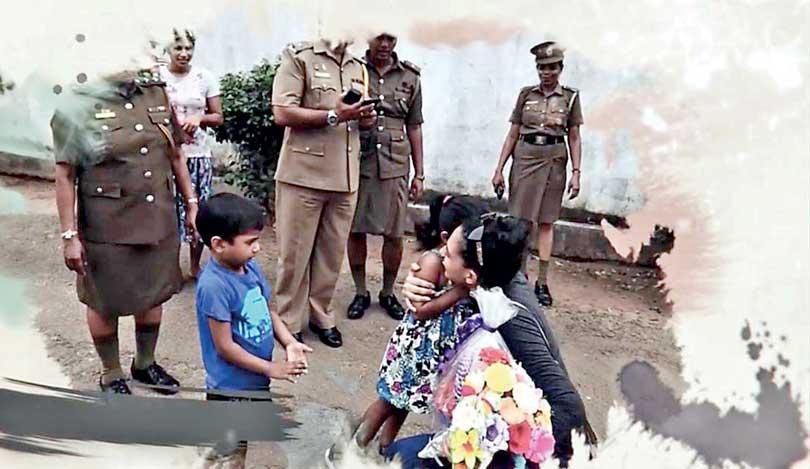
At the Women's Prison, with the Kids who welcomed us, in 2016
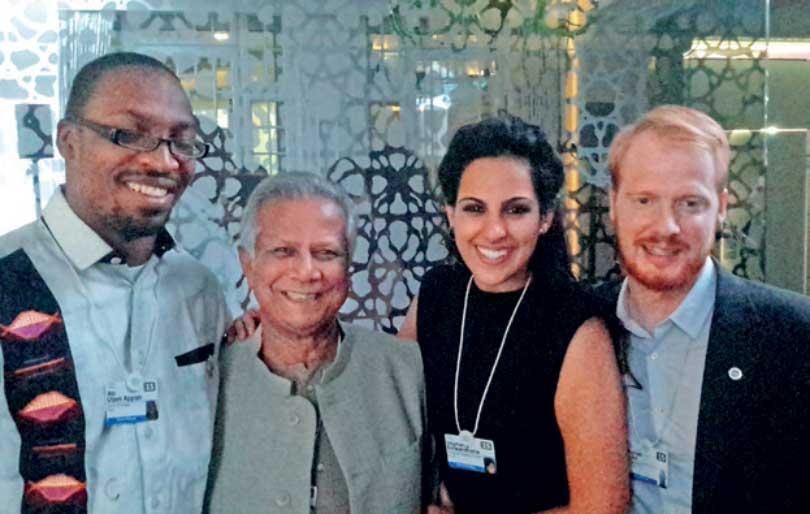
With Muhammad Yunus, 2006 Nobel Peace Prize winner at the World Economic Forum 2015
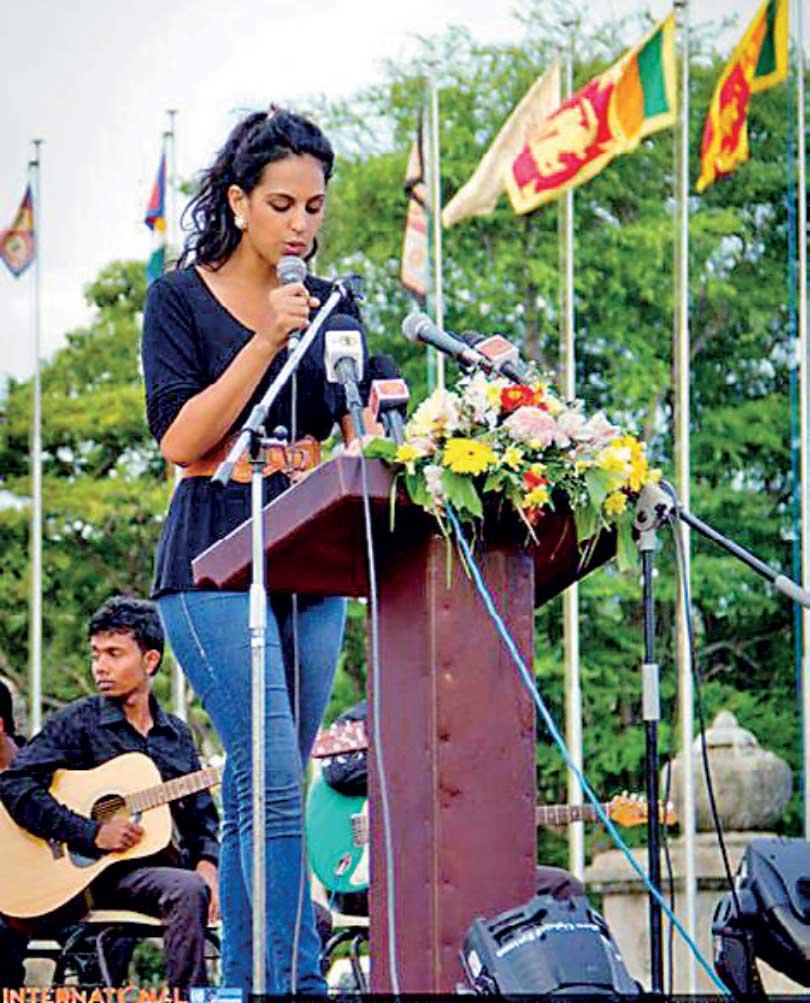
Delivering the keynote at International Youth Day
When Sri Lanka first encountered Stephanie Siriwardene on the pageant stage, winning titles, captivating audiences, and representing the island with poise, few could have predicted that her most consequential work would extend far beyond beauty and glamour. Today, Stephanie is no ordinary celebrity advocate.
She is the leader of two impactful social initiatives, a national mental health voice, and, most recently, a member of a high-profile prison oversight committee appointed by the government. But with prominence comes scrutiny, and her latest appointment has sparked a heated public debate about expertise, social credentials, and what it means to reform Sri Lanka’s justice system. To understand the relevance, and the controversy, one must look at the contours of who Stephanie Siriwardene is, what she has built, and why this moment resonates so powerfully in Sri Lanka’s social landscape.
From Beauty Queen to Builder of Systems
Stephanie Siriwardene’s rise into the public eye began with visibility. Crowned Miss Sri Lanka and later a regional titleholder in the Asian pageant circuit, she embodied the grace and confidence expected of national representatives. But unlike many pageant winners whose public lives fade into commercial endorsements or entertainment careers, Stephanie’s visibility became a foundation for social influence. In interviews and public speeches, she often spoke about seeing “beyond surface beauty” and caring for those whom society tends to ignore; a theme that would become literal in her later work.
An Education Outside the Ordinary
Stephanie’s education cannot be reduced to a diploma. She is notably the first Sri Lankan woman selected for Draper University’s Hero Training Programme, a rare fellowship designed to nurture entrepreneurial and social impact leaders. She has also been invited to attend the World Economic Forum Annual Meeting in Davos, a gathering of global policymakers and innovators. These experiences enriched her understanding of social challenges not just as charitable tasks, but as systemic problems requiring structured, long-term solutions; a key distinction that sets her work apart.
Infinite Grace Foundation: Reform Grounded in Respect
Central to Stephanie’s work is the Infinite Grace Foundation, an organisation that tackles five interconnected sectors; prison reform and rehabilitation, mental health support, addiction recovery, estate community development, and anti-human trafficking awareness. What defines this foundation is its policy-oriented approach, rejecting charity as a band-aid and favouring systems that build human dignity.
Redefining Punishment
One of the foundation’s most substantive areas of engagement has been criminal justice reform. In Sri Lanka’s overcrowded prison system, where petty offenders often languish alongside serious criminals, the foundation has advocated for, (i) legislative reform to allow fines or community service in lieu of custodial sentences for first-time petty offenders, reducing unnecessary incarceration, (ii) prisoner classification systems that ensure minor offenders are not housed with hardened criminals, aligning with international best practices, and (iii) post-release certification and employability programs to ensure that former inmates can reintegrate into society with opportunities, not just stigma. Her foundation’s work is not theoretical. It is built on engagement with lawyers, prison authorities, community leaders, and international reform advocates, even before the government formally recognised Sri Lanka’s need for institutional change in this arena.
I See You: Mental Health as a Human Right
If Infinite Grace is the policy engine, I See You is Stephanie’s emotional and cultural project. Launched as a deeply personal movement rooted in her own journey with mental wellness, I See You expanded into a multi-lingual campaign that uses music, public dialogue, workshops, and creative installations to normalise mental-health conversations, especially in communities where stigma is entrenched. Unlike many awareness campaigns, I See You does not stop at visibility; it partners with professionals to ensure referral systems, support networks, and, crucially, a sense of community around people who suffer in silence.
Appointment to the Prison Oversight Committee: Recognition or Reckoning?
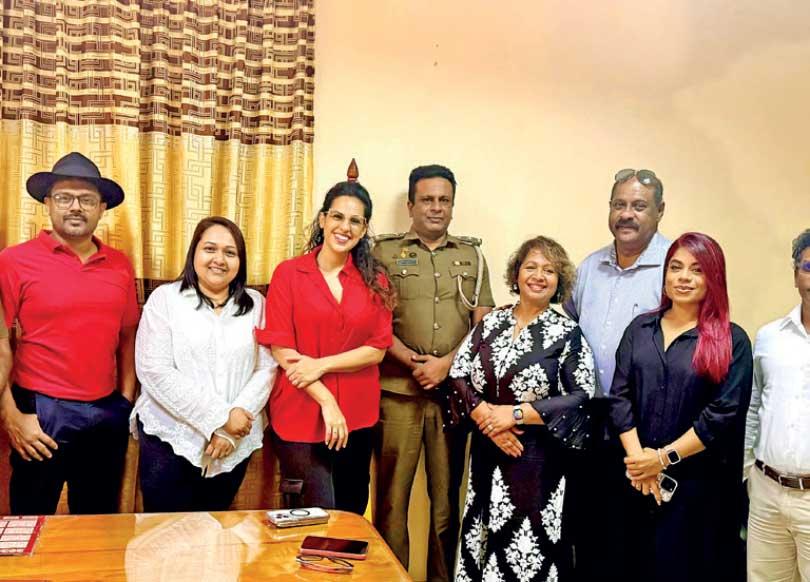
In late 2025, the Sri Lankan government, under the leadership of Minister of Justice Harshana Nanayakkara, appointed Stephanie Siriwardene to a special committee tasked with monitoring inmate welfare and prison administration; a role that combines oversight, advocacy, and systemic reform input. For many, the appointment was long overdue: a formal acknowledgement that someone with sustained on-ground experience in prisons, deep community engagement, and a decade of policy-adjacent reform work deserved a seat at the table where change is shaped, not merely discussed. Yet the announcement triggered an immediate and highly charged online backlash. While public debate around governance appointments is both healthy and necessary, much of the reaction directed at Stephanie was neither balanced nor substantive. Instead, it veered sharply into gendered scrutiny, exposing the deeply entrenched sexism that continues to police women’s authority in public life. Social media commentary fixated disproportionately on her identity as a former beauty queen, television presenter, and model, credentials repeatedly weaponised to undermine her legitimacy. Critics dismissed her as “media-oriented” or “cosmetic,” often without engaging with the substance of her prison reform work, policy advocacy, or years of institutional engagement. Male appointees to similar committees are rarely asked to justify their past professions in this way; for women, visibility is too often reframed as frivolity. More troublingly, the tone of much of the criticism crossed from scepticism into misogyny, reducing Stephanie to appearance, past titles, or presumed inadequacy, rather than evaluating her actual contributions. The implicit message was unmistakable: that a woman who has occupied public, aesthetic, or entertainment spaces must perpetually prove her intellectual and moral authority, while men are presumed competent by default. At the same time, a significant number of voices pushed back against this narrative. Supporters argued that her so-called “outsider” perspective is precisely what Sri Lanka’s prison system needs, someone capable of bringing empathy, public accountability, and reform-minded thinking into a space long shielded from scrutiny. They noted that lived engagement, social impact leadership, and the ability to mobilise public attention are not weaknesses, but assets in a system desperate for transparency and trust. This controversy, therefore, is not merely about one appointment. It exposes a larger fault line in Sri Lanka’s public discourse; how women’s expertise is judged, how leadership is gendered, and who is deemed ‘qualified’ to influence governance.
In interrogating Stephanie Siriwardene’s appointment, the nation is also being forced to confront its own biases, about power, credibility, and who is allowed to lead beyond traditional moulds.
Why Her Appointment Matters
Marriage of Influence and Impact: What Stephanie brings to the committee is not a traditional résumé; it is influence that is grounded in long-term, on-ground engagement. Many reform committees struggle with insularity, composed solely of experts who speak to one another in technical language, detached from public sentiment. Stephanie’s presence bridges this gap: she speaks fluently to communities, media, policymakers, and international partners.
A Voice for the Marginalised: Unlike many advocates whose passion fades with time, Stephanie’s portfolio shows sustained commitment:
Working inside prisons,
Designing reintegration programs,
Advocating alongside families,
And campaigning for mental health without sensationalism.
This is not transient activism; it is ecosystem building
Diversity of Perspective: Criminal justice isn’t just a matter of enforcement; it is also a public-health, social-development, and human-rights issue. The committee benefits from diverse thought, not as a token, but as a strategic imperative.
The Broader Stakes: Sri Lanka at a Crossroads
Sri Lanka’s challenges with incarceration, mental health, and social reintegration are not unique, but they are urgent. Overcrowded prisons, the absence of rehabilitation pathways, and widespread stigma against mental illness have consequences that reverberate through families and communities. At this critical juncture, the nation’s choice of voices, not just policies, matters. Stephanie’s appointment signals something larger; that governance is no longer confined to bureaucratic silos, and that civil society’s ideas can shape institutional reform.
A Life of Seeing: Beyond Surface Limits
Stephanie Siriwardene’s journey defies simple categorisation. From Miss Sri Lanka to international forums, from music and mental-health campaigns to prison corridors and committee rooms, she has inhabited worlds few traverse. Her critics ask whether she is “qualified.” Her supporters ask whether expertise can coexist with empathy. Perhaps the true question is whether Sri Lanka is ready to consider a new model of public leadership, one that combines visibility with accountability, compassion with strategy, and systems thinking with human engagement. In a society that often forgets the unseen, Stephanie Siriwardene’s work asks us to see more, prisoners as citizens, mental health as a right, and reform as continuous, collective work. Whether history remembers her for the crown or the causes, one thing is clear: she stepped into the broader, harder arenas, and invited the rest of us to look deeper.