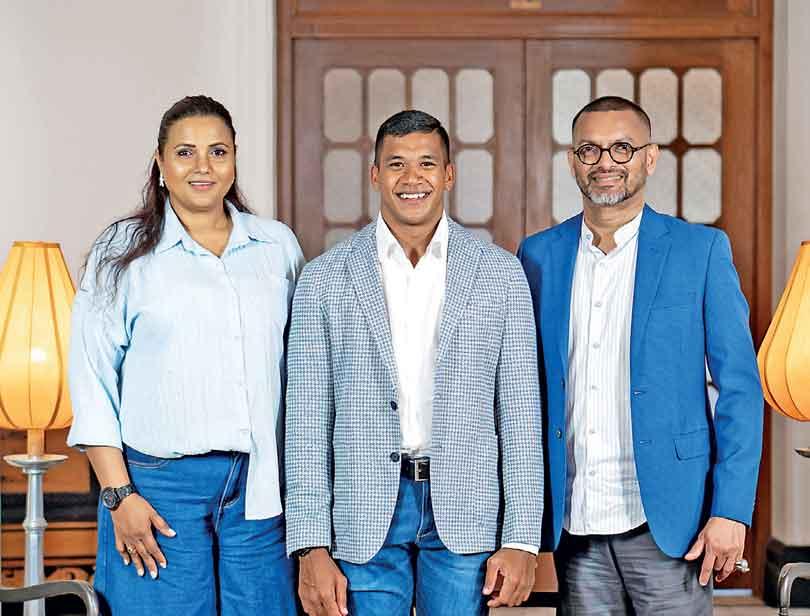

 In this week’s episode of Fame Game, hosts Kumar de Silva and Rozanne Diasz sat down with one of Sri Lanka’s most respected rugby players, Nigel Ratwatte. Known for his calm demeanor both on and off the field, Nigel recently announced his retirement from competitive rugby after a long and successful career. In this candid conversation, he opens up about his journey, life beyond the sport, his love for nature, and his plans for the future.
Q: Let’s get to know you beyond rugby. How would you describe yourself?
A: I would say I am a humble and down-to-earth person. I love the beach, surfing, and nature. I try to stay away from the city as much as possible. I am happiest when I am close to nature.
Q: We’ve heard that you’re also a devoted family man.
A: Yes, I am. I cannot stay away from my family. It is true that they are my best friends. We do everything together and travel together whenever we can.
Q: You seem to have a lot of energy. Does that come from your training or from your love for chocolate?
A: Both, actually. I love my gym sessions, but I am also a huge fan of Lindt chocolates. I think it is the milk and the texture. Nothing else compares.
Q: Do you keep a check on your sugar levels?
A: Yes, my wife and I do a full medical check every January. So far, everything is fine and there are no issues at all.
Q: You have recently retired from professional rugby. What made you take that decision?
A: I have played the game for many years and enjoyed every moment of it. I have always believed it is best to retire when you are at your peak, not when people start saying it is time to stop. I wanted to leave the sport on a high note with good memories.
Q: Rugby has been such a big part of your life. How do you plan to stay connected to it now?
A: I do not think I can ever be completely away from rugby. I have not taken up coaching yet, but I am always open to helping the younger generation. If any player or team wants my guidance, I will be more than happy to share my experience.
Q: Let’s talk about your love for Sri Lankan food. We heard you are obsessed with pol roti.
A: Absolutely. Pol roti is my favourite. I travel a lot around the island to the east, south, and hill country, and I always look for locals who make the best roti. I love the kind that is slightly burnt and spicy. It is perfect.
Q: You have lived in several countries including Mauritius and South Africa, yet your love for Sri Lankan culture and food is strong. How did that develop?
A: Even abroad, I was always surrounded by food similar to what we have here. In Mauritius, I used to eat Indian-style roti, so the love for it just continued. I guess it is part of who I am.
Q: Your home in Kandy is surrounded by nature. Has that led to some interesting encounters such as snakes?
A: Yes, plenty. We live close to a jungle, so snakes are part of life. At first, I was terrified, but over time I have learned to handle them, though I still get scared sometimes.
Q: On match days, do you have a particular routine you follow?
A: Definitely. I start my day with a good coffee, which I make myself using precisely eighteen grams of coffee. Then I head to the gym for about thirty to forty minutes, have breakfast, and take it easy until match time. I only start focusing fully about twenty minutes before the warm-up.
Q: Are you the motivational type in the dressing room?
A: Not really. I am more of a calm and analytical player. I like to give my teammates clear instructions about the game plan. I am not the shouting or aggressive type; others in the team take on that role. I believe in giving the right information and keeping the team focused.
Q: What has been your most intense match to date?
A: The match we lost to CR and FC in Kandy last year. That loss hurt the most because we had not lost to them in a long time. It stayed with me until we beat them again in Colombo and Kandy this year. I did not want to retire with a loss against them.
Q: People often see rugby players as tough and intimidating. Are you as calm off the field as you are on it?
A: Yes, I think so. I am very easygoing and prefer peace over aggression. But in a team, it is good to have a mix of personalities. Some tough players and some calm ones. That balance makes a strong side.
Q: You studied at Trinity College Kandy until Grade Six and then moved abroad. Do you ever regret not playing rugby in Sri Lanka during your early years?
A: Not really. My time in South Africa taught me a lot about different cultures and respecting diversity. That experience shaped me as a person. If I had stayed in Sri Lanka, I might not have gained that exposure. So I have no regrets.
Q: Would you like your son to follow in your footsteps and play rugby?
A: Only if he wants to. Right now, he is interested in football and surfing. He trains in rugby on weekends, but I am letting him explore his interests freely. He is still young, so I do not want to push him.
Q: If you were to settle permanently in one place, would it be Kandy or Colombo?
A: Neither. I would choose Komari, near Arugam Bay. It is peaceful, surrounded by nature, and has great surf spots. Hardly anyone knows you there, which makes it the perfect escape.
Q: Have you ever had unusual experiences as a public figure, such as being stalked or receiving hate messages?
A: Thankfully, no. I have only received positive messages and appreciation from fans, which I am very grateful for.
Q: Do you miss the limelight after retirement?
A: Not really. I think I have achieved what I wanted in rugby. It is time for the next generation to take over. I am happy focusing on my family and business ventures now.
Q: You have faced many injuries over the years. How did you cope with them?
A: Injuries are part of the sport. I have had several, including broken wrists and both ACLs. Recovery takes months, but the motivation to get back on the field keeps you going.
Q: Looking back, was it all worth it?
A: Absolutely. The pain fades, but the memories and pride of playing for your country last forever.
Q: Do you think lack of government support is a reason rugby has not developed as much as cricket in Sri Lanka?
A: Partly. We do not have enough international exposure or tournaments. We are still ranked within Asia, and to move up, we need a stronger system and consistent planning from the administration.
Q: How long do you think it would take Sri Lanka to rise in Asian rankings?
A: For Sevens rugby, not too long. We have the talent, but we need structure and consistency. If the right system is put in place, we can progress rapidly.
Q: Let’s talk about your personal interests such as surfing, wildlife, and nature. Do they make you feel content?
A: Very much. Anything to do with water makes me happy. I love surfing, swimming, and being close to nature. It keeps me grounded and peaceful.
Q: How do you stay focused during pressure moments, like a deciding kick when the crowd is roaring?
A: It is all about focus and mental training. When I am preparing for a kick, I do not hear the crowd at all. It is like the sound fades away. I just see the goalposts and the ball. That concentration comes from practice and discipline.
Q: Was there a memorable moment like that in your career?
A: Yes, during the Knockout Finals against CR and FC in 2015 and 2016. I had a fifty-metre kick that decided the match. The feeling after that win, the dressing room celebration, and the camaraderie are unforgettable.
Q: How do leaner or smaller-built players survive in such a physical sport?
A: Rugby is not only about size. Smaller players can be fast, agile, and strategic. It is about adapting your style and developing your strengths. A strong mindset is the most important thing. If you are mentally tough, you can play rugby.
Q: Have you done any brand endorsements during your career?
A: Yes, a few. I am grateful for those opportunities. It is a short career span, so you have to make the best of it.
Q: Now that rugby is behind you, tell us about your new venture, Niket Villas.
A: My wife and I started Niket Villas, named after our son. We have two properties, one in Arugam Bay and another in Kandy, and we are also partners in another property called Nil Ralle in Galle. It is a family-run business, and we both love being hands-on with it. It is close to the sea and combines our love for nature and hospitality.
Q: Finally, what advice would you give young players aspiring to represent Sri Lanka?
A: Have a clear goal and work towards it with patience and discipline. There will be challenges, injuries, and setbacks, but never give up. Stay humble, respect others’ ideas, and constantly improve your technique. Hard work always pays off in the end.