Parasakthi A Powerful Look at Language, Identity, and Resistance in 1960s Tamil Nadu

 Parasakthi stands as a powerful cinematic exploration of language, identity, and resistance, rooted deeply in one of the most defining political movements in Tamil Nadu’s history. Directed by Sudha Kongara and produced by Aakash Bhaskaran under the banner of Dawn Pictures, the film revisits the anti Hindi imposition agitations of the late 1950s and 1960s. Rather than functioning as a conventional historical retelling, Parasakthi chooses a deeply human approach, weaving political ideology into the intimate lives of its characters. Through this method, the film successfully reminds viewers that debates surrounding language were never abstract political arguments but deeply personal struggles that affected dignity, livelihood, and cultural survival.
Set during a turbulent period in post independence India, Parasakthi situates itself in a Tamil Nadu grappling with the fear of linguistic erasure. The push to establish Hindi as a unifying national language was met with fierce resistance in the southern states, particularly in Tamil Nadu, where language was inseparable from cultural identity and self respect. The film captures this tension not through sweeping political speeches alone, but through lived experiences, quiet humiliations, and moments of awakening that shape its characters. This grounding is what gives Parasakthi its emotional and intellectual weight.
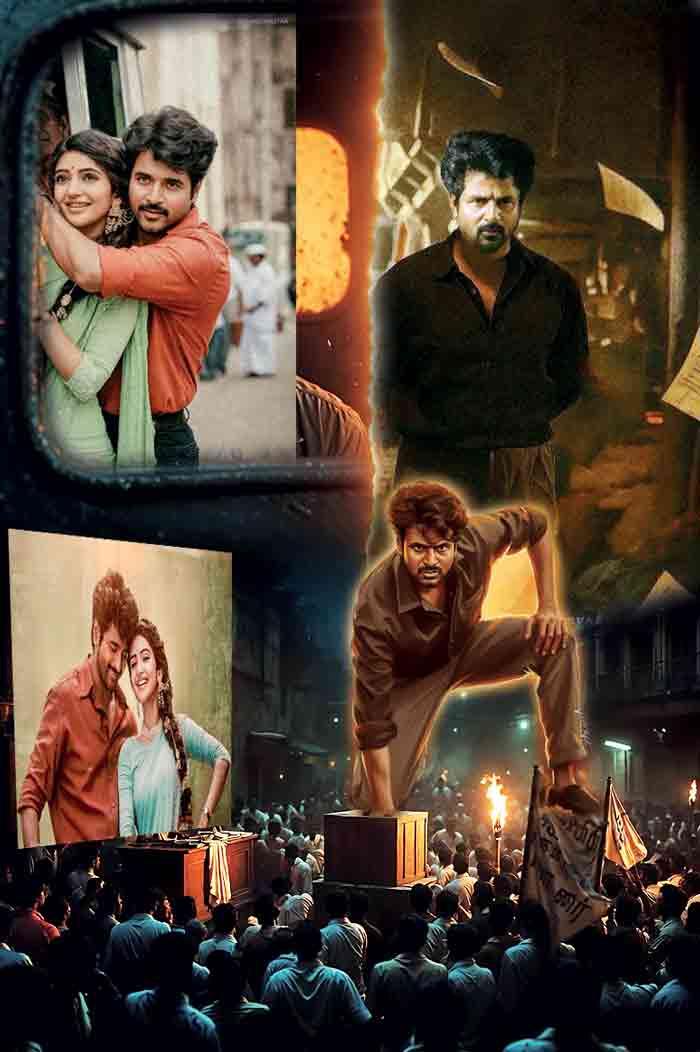
At the center of the narrative is Chezhiyan, an idealistic and fiercely committed young man who leads a radical student organization known as the Purananuttru Padai. The group is formed in direct opposition to Hindi imposition and embodies the anger and urgency of a generation that feels unheard by those in power. In its early stages, the movement is intense, uncompromising, and fueled by the belief that extreme resistance is justified when existence itself feels threatened. Chezhiyan emerges as a charismatic leader, driven by conviction and a sense of moral duty, yet burdened by the immense responsibility of guiding others.
However, the film does not glorify extremism without consequence. One tragic incident resulting from the group’s actions leaves Chezhiyan emotionally broken and riddled with guilt. This turning point is crucial, as it strips the character of his certainty and forces him to confront the cost of radical resistance. Haunted by loss and disillusionment, Chezhiyan retreats from activism, choosing instead to live a quieter life away from political turmoil. He takes up work as a steam locomotive fireman, a physically demanding and humble job, symbolizing both his desire for anonymity and his attempt to rebuild himself through honest labor.

Sivakar Thikeyan
Chezhiyan’s withdrawal from the movement is not portrayed as cowardice but as emotional exhaustion. The film treats his trauma with sensitivity, allowing space for silence, regret, and internal conflict. His decision is also influenced by his responsibility toward his younger brother, Chinnadurai, whom he supports financially and emotionally. This familial bond forms the emotional backbone of the film and provides a lens through which the broader political narrative is examined.
Chinnadurai begins the story as a sharp contrast to his elder brother. An engineering student with ambitions of a comfortable future, he is initially carefree and largely indifferent to politics. For him, ideology feels distant and unnecessary, something that disrupts stability rather than protects it. He admires his brother but does not fully understand the fire that once drove Chezhiyan. This distance is essential to the film’s structure, as it allows the audience to witness a gradual and organic political awakening rather than an instant transformation.
As Chinnadurai navigates everyday life, he encounters the subtle yet devastating consequences of language barriers. The film excels in portraying these moments with restraint and realism. A particularly poignant scene involves an elderly woman struggling to access official services because she cannot understand Hindi. There is no dramatic background score or exaggerated confrontation, only quiet frustration and helplessness. It is in these moments that Chinnadurai begins to recognize how language policies affect ordinary people, turning basic rights into privileges reserved for those fluent in a particular tongue.
These experiences slowly reshape Chinnadurai’s worldview. His journey toward political consciousness is marked by empathy rather than anger. Unlike Chezhiyan, who entered the movement through ideological passion, Chinnadurai is drawn in through lived injustice. This distinction enriches the narrative, presenting resistance as something that can arise from compassion as much as from rage. As he becomes involved in the very movement Chezhiyan abandoned, the brothers find themselves moving in opposite emotional directions, creating a compelling internal conflict that mirrors the larger societal divide.
The film skillfully brings the brothers back together, not simply through shared ideology, but through mutual understanding. Their reconciliation is not about agreeing on methods, but about recognizing that the core of the struggle lies in dignity, access, and the right to preserve one’s cultural identity. Parasakthi emphasizes that resistance is not limited to protests, slogans, or violent confrontations. It exists in classrooms, workplaces, government offices, and homes. It is about ensuring that future generations can live without having to translate themselves to be heard.

Atharva
Sivakarthikeyan delivers one of the most restrained and mature performances of his career as Chezhiyan. Known primarily for his lighter roles, he surprises with a portrayal that relies on subtlety rather than theatrics. His Chezhiyan is a man torn between conviction and fatigue, fire and fear. Sivakarthikeyan conveys this duality through controlled expressions and quiet moments, allowing the audience to feel the weight of his internal struggle. It is a performance that marks a significant evolution in his acting journey.
Ravi Mohan appears as Thirunaadan, an intelligence officer whose presence adds tension and complexity to the narrative. Rather than being a one dimensional antagonist, his character represents the machinery of the state, operating with efficiency and moral ambiguity. Ravi Mohan brings a composed intensity to the role, making Thirunaadan both intimidating and intriguing. His interactions with Chezhiyan elevate the film’s dramatic stakes and highlight the imbalance of power between the individual and the system.
Atharvaa stands out as Chinnadurai, delivering a performance filled with natural charm and sincerity. His transformation from apathy to commitment feels believable and earned, thanks to his understated acting. Atharvaa excels in scenes that require quiet realization, allowing emotion to surface gradually. His chemistry with Sivakarthikeyan strengthens the emotional core of the film, making their brotherly bond feel authentic and deeply rooted.
Sreeleela makes her Tamil debut as Ratnamala, a student leader who brings warmth and emotional softness to the otherwise intense narrative. While her character plays an important role in representing youthful idealism and hope, the writing does not fully explore her potential. Nevertheless, Sreeleela’s screen presence is engaging, and she brings sincerity to her performance. The supporting cast complements the leads effectively, adding depth without overshadowing the central story.

Ravi Mohan
Parasakthi opens on a strong and confident note, immediately immersing the audience in its historical setting. The first half is tightly paced and politically charged, filled with scenes that leave a lasting impression. The film succeeds in making a historical issue feel immediate and relevant, drawing clear parallels to contemporary debates around language and identity. Sudha Kongara avoids turning the narrative into a lecture, instead using personal stories to explain complex ideas such as the difference between unity and uniformity.
One of the film’s greatest strengths lies in its depiction of everyday struggles during the 1960s. From railway stations to government offices, the film captures the quiet alienation experienced by those who found themselves excluded by language. These scenes are handled with sensitivity, allowing the audience to understand the emotional toll without overt dramatization. The dialogues are powerful and thoughtfully written, with several lines resonating long after the film ends. Importantly, Parasakthi does not romanticize the past. It acknowledges the sacrifices, the fear, and the loss that accompanied the fight for linguistic dignity.
The music plays a supportive role, enhancing emotional moments without overpowering the narrative. The background score is particularly effective during scenes of internal conflict and collective resistance. The interval block stands out as one of the film’s most impactful moments, delivering a powerful combination of emotion, tension, and mass appeal.
Despite its strong foundation and sincere intentions, Parasakthi does not entirely fulfill its potential in the second half. The narrative begins to lose focus as it leans into familiar commercial tropes, including personal vendettas and extended action sequences. In a story where systemic oppression serves as a compelling antagonist, these elements feel somewhat unnecessary and occasionally distracting. The pacing becomes uneven, causing certain emotional moments to lose their intended impact.

Sree Leela
At times, the film adopts a documentary like tone that, while informative, may distance viewers from the emotional core of the drama. The romantic portions, though pleasant and well performed, slightly dilute the intensity of the central conflict. Sreeleela’s character, in particular, could have been written with greater depth to leave a stronger and more lasting impression.
The climax, though ambitious in scope, does not quite match the emotional power of the interval sequence. A more restrained and grounded approach might have allowed the film to end on a stronger note, reinforcing its core message without relying on spectacle.
Overall, Parasakthi remains a significant and thought provoking film that tackles a complex and emotionally charged chapter of Tamil Nadu’s history with sincerity and ambition. While it falters in places, its strengths far outweigh its shortcomings. By centering its narrative on human experiences rather than political rhetoric alone, the film succeeds in reminding audiences why language matters, not just as a means of communication, but as a foundation of identity, dignity, and resistance.