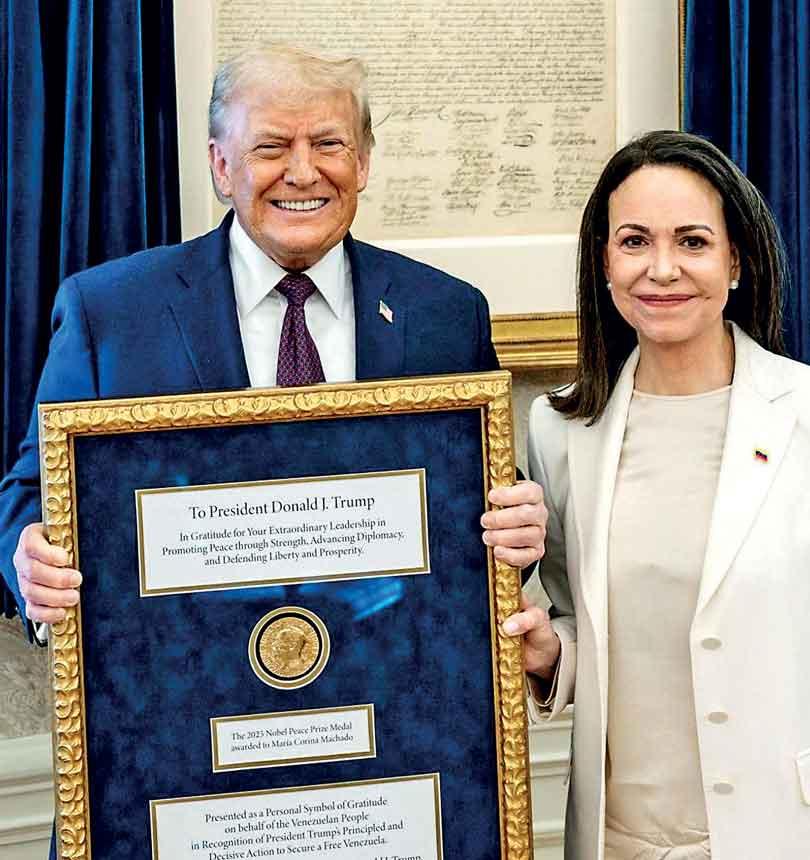
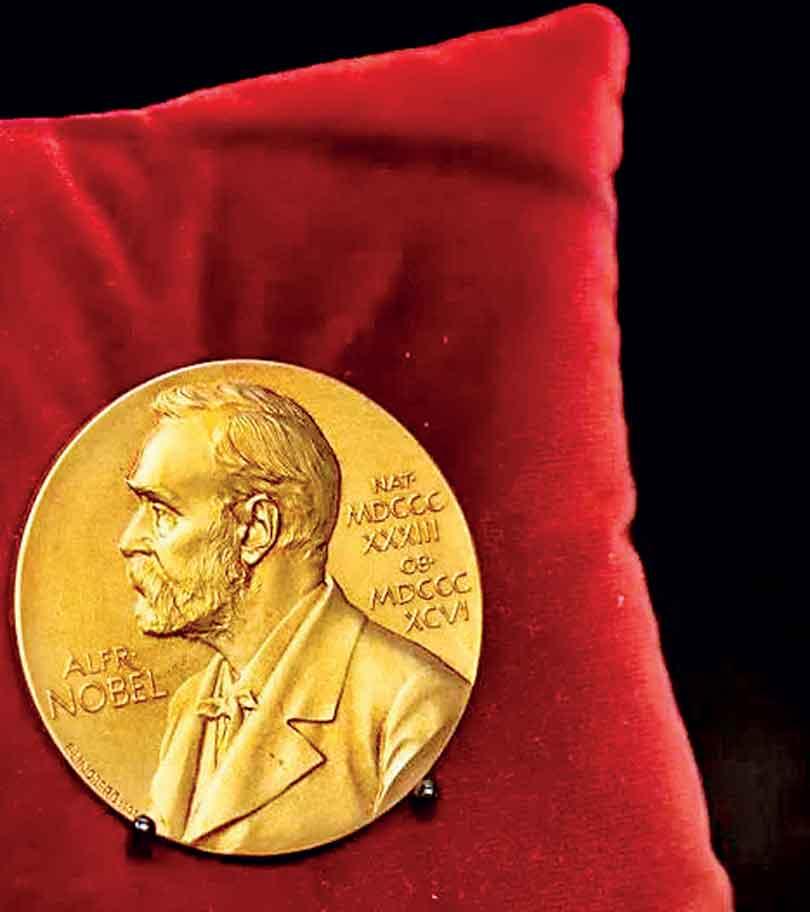
In January 2026, a striking and controversial scene unfolded inside the White House in Washington. Venezuelan opposition leader Maria Corina Machado stood beside President Donald Trump and placed in his hands the gold medal she had received only weeks earlier as part of the Nobel Peace Prize. The image of President Trump holding the framed medal travelled instantly across television screens, newspapers, and social media platforms around the world. For some, it looked like a historic gesture of gratitude. For others, it appeared deeply political, deeply awkward, and deeply misleading.
What happened that day was not simply a photo opportunity. It became a focal point in a much larger story about Venezuela, democracy, American power, and the meaning of one of the world most prestigious awards. The moment raised difficult questions about symbolism, legitimacy, and the fine line between honour and propaganda in international politics.
To understand why the medal mattered so much, it is necessary to return to the previous year. In October 2025, the Norwegian Nobel Committee announced that Maria Corina Machado would receive the Nobel Peace Prize. The committee praised her persistent struggle for democratic rights in Venezuela, a country that had endured years of authoritarian rule under President Nicolas Maduro. At the time of the announcement, Machado was not free. She was living in hiding inside Venezuela, constantly at risk of arrest, surveillance, or forced disappearance.
Her selection as laureate was widely seen as a bold political statement by the Nobel Committee. It signalled international recognition of the Venezuelan opposition movement and cast a harsh moral judgement on the Maduro government. Many human rights organisations welcomed the decision, arguing that it gave hope to millions of Venezuelans living in exile or under repression. Supporters described Machado as a courageous figure who had refused to compromise her principles despite personal danger.
Yet even then, her relationship with President Donald Trump complicated the narrative. Machado publicly thanked President Trump for his role in supporting Venezuelan democracy. She argued that his policies had weakened Maduro and created pressure for political change. Critics disagreed, pointing out that Trump often treated foreign policy as transactional rather than principled, particularly in countries with large oil reserves such as Venezuela.
In December 2025, Venezuelan opposition leader María Corina Machado secretly left Venezuela in defiance of a government-imposed travel ban and undertook a perilous journey to Oslo, Norway, in an attempt to be present for the Nobel Peace Prize celebrations; a journey her supporters described as dangerous and heroic. However, she did not arrive in time for the official Nobel ceremony on the 10th of December; her daughter, Ana Corina Sosa Machado, accepted the prize on her behalf at Oslo City Hall and delivered an acceptance speech quoting her mother’s message of resistance and hope.
After the ceremony, Machado reached Oslo and made her first public appearance in months. While there she spoke to international audiences about freedom, justice, and the plight of ordinary Venezuelans, dedicating the Nobel Peace Prize to the Venezuelan people and to all those who have fought against dictatorship.
Only a few weeks later, however, the story took an unexpected turn. On January 15, 2026, Machado arrived in Washington for a meeting with President Donald Trump. Cameras captured the moment when she presented him with her Nobel medal. She explained that she wanted to recognise his support and that the gesture symbolised a bond between the United States and Venezuelans struggling for liberty. She even compared the act to historical exchanges between American and Latin American revolutionary figures.
President Trump accepted the medal with visible pride. He posed for photographs and later described the moment as a sign of mutual respect. His supporters hailed it as proof that he deserved recognition for his foreign policy achievements. His critics mocked the scene, arguing that he had effectively been handed an award he had not earned.
Almost immediately, confusion spread. Many headlines suggested that President Trump had received the Nobel Peace Prize. Others claimed that Machado had transferred the prize to him. Within hours, fact checkers and political commentators rushed to clarify what had actually happened.
The Norwegian Nobel Committee stepped in to make its position unmistakably clear. Officials explained that while a laureate is free to give away the physical medal, the title of Nobel Peace Prize winner cannot be transferred. It is permanently attached to the person chosen by the committee. In other words, Machado remained the official laureate, and President Trump did not become a Nobel winner simply by receiving the medal.
This distinction is crucial. The Nobel Peace Prize is not just an object made of gold. It is an internationally recognised honour recorded in history. Many laureates over the years have sold, donated, or gifted their medals, but their status as winners has never changed. Likewise, the recipient of Machado medal did not change the official record.
Reactions to the White House scene were sharply divided. In Norway, some politicians described Machado decision as inappropriate and damaging to the reputation of the Nobel Prize. They argued that the award should represent universal values rather than personal political alliances. Others defended her right to do whatever she wished with her medal, even if they disliked her choice.
In Venezuela, the episode deepened existing tensions within the opposition movement. Some activists admired Machado loyalty to Trump, believing he had played a key role in Maduro removal earlier in January 2026. Others worried that aligning too closely with an American leader risked undermining Venezuelan sovereignty and credibility.
The situation became even more complex because of President Trump own stance toward Venezuela. Although his administration had supported Maduro capture in early January, President Trump also expressed approval of Delcy Rodriguez, a former Maduro ally who remained in power as interim leader. This contradiction left many observers puzzled. If President Trump truly backed democracy, why would he endorse a figure linked to the old regime instead of fully supporting Machado?
Machado found herself walking a difficult political tightrope. On one hand, she needed international backing to rebuild Venezuela and protect democratic institutions. On the other, she faced criticism at home for appearing too dependent on foreign powers, especially the United States.
Beyond Venezuela, the incident sparked a broader debate about the Nobel Peace Prize itself. Some argued that the award had become increasingly politicised in recent years. They pointed to past laureates whose actions later appeared inconsistent with the ideals of peace and human rights. Others insisted that the prize remained a powerful symbol of moral authority, precisely because it provoked such passionate discussions.
The Washington ceremony also highlighted the continuing global fascination with the Nobel brand. Few honours carry the same weight or prestige. For many world leaders, winning or even being associated with a Nobel Prize represents ultimate validation. President Trump had previously hinted that he believed he deserved the Peace Prize for his role in international negotiations, making Machado gesture particularly resonant.
Yet symbolism alone cannot resolve the real challenges facing Venezuela. The country remains deeply divided, economically devastated, and politically fragile. Millions of citizens continue to struggle with poverty, migration, and uncertainty. Whether Machado or Rodriguez ultimately leads the nation, the road toward stable democracy will be long and painful.
Some analysts see Machado decision as a calculated move. By honouring President Trump, she may have hoped to secure stronger American support for rebuilding Venezuela institutions, holding free elections, and prosecuting corruption. Others view it as a risky gamble that could alienate key allies in Europe and Latin America.
Meanwhile, President Trump acceptance of the medal fit neatly into his personal narrative of being a misunderstood leader whose achievements are overlooked. Supporters celebrated the moment as proof that he deserved more recognition on the world stage. Opponents dismissed it as a theatrical stunt that distorted the meaning of the Nobel Prize.
In Oslo, the Nobel Committee tried to distance itself from the controversy without openly criticising Machado. Officials reiterated that laureates are independent individuals who make their own decisions. Still, the uncomfortable nature of the episode was impossible to ignore.
Ultimately, the story is less about a piece of gold and more about power, perception, and legitimacy. A medal can be handed over in seconds, but the moral authority of a Nobel Prize rests on collective judgement, historical record, and shared values.
Maria Corina Machado will always be remembered as the Nobel Peace Prize laureate of 2025. Her struggle against authoritarian rule, her time in hiding, and her dramatic journey to Oslo form part of that legacy. Donald Trump may display her medal in his office or museum, but history books will not list him as a Nobel winner.
The image of that exchange in Washington will likely endure as one of the most unusual moments in modern diplomatic history. It encapsulates the contradictions of our era, a world in which symbols move faster than substance and political theatre often overshadows genuine progress.
For Venezuela, the deeper question remains unresolved. Can the nation truly achieve democracy after years of repression, economic collapse, and international interference? Can leaders like Machado balance gratitude to foreign allies with loyalty to their own people?
For the Nobel Peace Prize, the episode serves as a reminder that even the most respected honours can become entangled in global power struggles. The challenge is to preserve their meaning while acknowledging the messy realities of politics.
In the end, the medal handed to President Trump may shine brightly, but it is Machado story that carries the weight of history. Her fight for freedom continues, and the true test of peace will not be found in Washington photographs, but in the lives of ordinary Venezuelans seeking dignity, stability, and hope.