Wuthering Heights 2026 Is a Beautifully Made Storm of Desire and Damage!
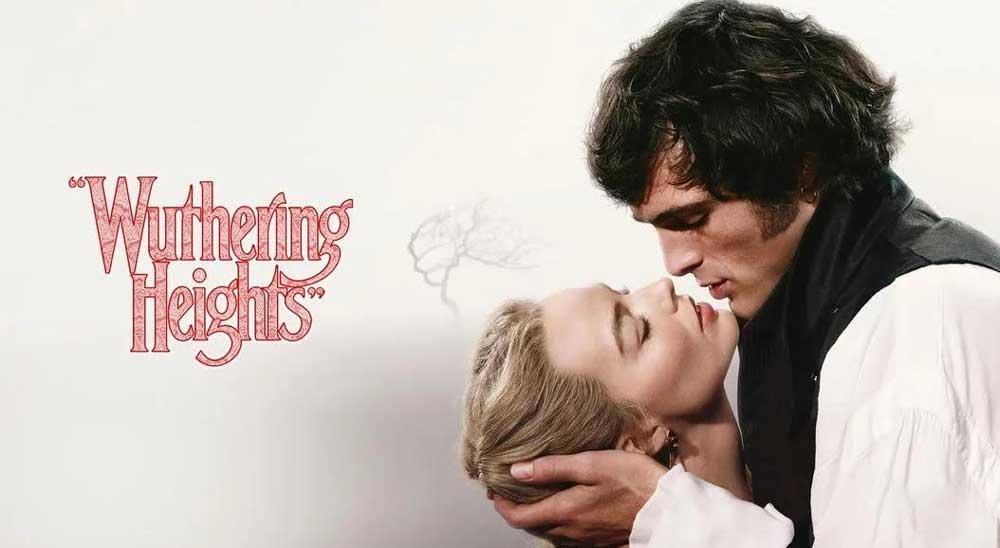
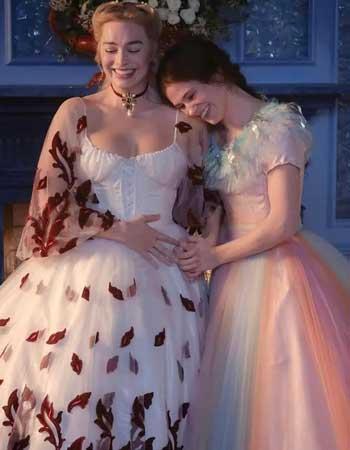 Emerald Fennell’s 2026 adaptation of Wuthering Heights arrives with the weight of expectation and controversy already built into its DNA. Emily Brontë’s novel has resisted definitive screen translation for decades, partly because its violence of feeling and moral ambiguity are so deeply tied to its strange narrative structure and its bleak, elemental setting. Fennell approaches the material not as a dutiful period dramatist but as a provocateur with a taste for excess. The result is a film that is arresting to look at, emotionally confrontational in its best moments and frequently frustrating in its refusal to sit with the novel’s complexity. It is bold cinema that courts division rather than consensus.
From the opening scenes, it is clear that this is not a reverent adaptation. The film compresses the novel’s multi-generational sprawl into a tighter emotional chamber focused almost entirely on the destructive bond between Catherine Earnshaw and Heathcliff. Fennell strips away much of the novel’s narrative scaffolding, including the distancing devices that allow Brontë’s story to unfold through recollection and hearsay. What replaces that layered structure is immediacy. The camera is intimate and invasive, often hovering close to faces, skin and breath. The moors are less a metaphysical presence than a sensual landscape of wind, mud and physical exposure. This choice makes the film feel raw and contemporary in its emotional rhythms, even as the period setting remains intact.
Margot Robbie’s Catherine is a performance of fierce volatility. She plays Catherine as a woman constantly at war with herself, swinging between reckless joy, cruelty and aching vulnerability. Robbie leans into Catherine’s contradictions rather than smoothing them over. There is a genuine sense that this character delights in her own capacity to wound and be wounded. At the same time, the script rarely allows her moments of quiet interiority. Catherine is almost always in motion, almost always performing her feelings outwardly, which gives the performance intensity but limits its range. You believe in her capacity for obsession and self-sabotage, but you are rarely invited into the reflective spaces that make Catherine tragic rather than merely destructive.
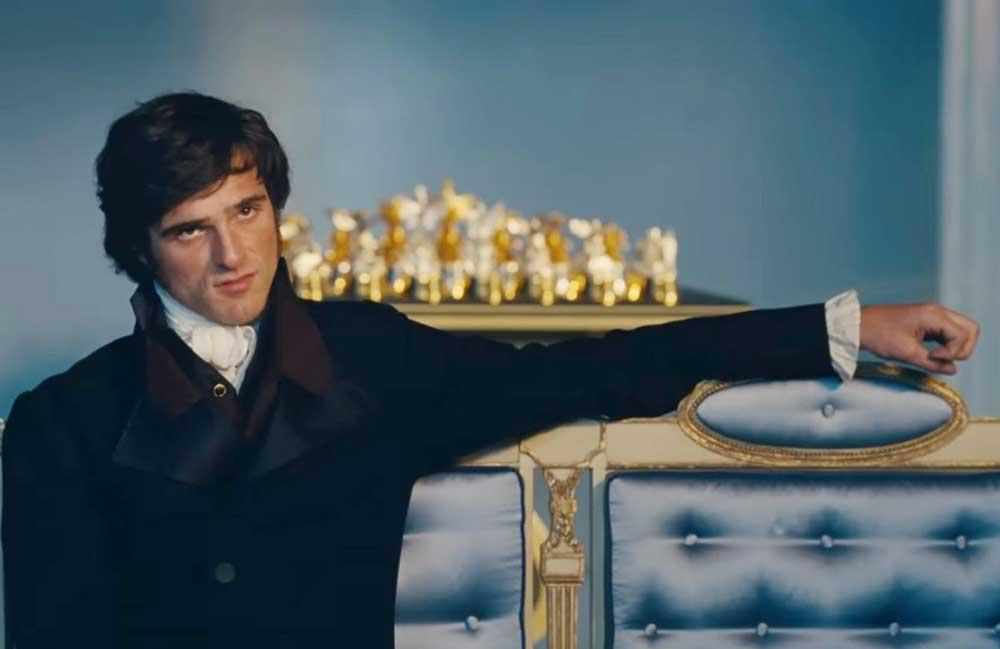
Jacob Elordi’s Heathcliff is physically imposing and emotionally feral. Elordi brings a brooding magnetism to the role, and his Heathcliff often feels like a figure carved from resentment and desire in equal measure. In moments of rage, he is genuinely frightening. In moments of longing, he allows vulnerability to flicker across his otherwise guarded presence. The problem is not commitment but texture. Heathcliff’s cruelty and pain are foregrounded so relentlessly that the character risks becoming one dimensional in his extremity. The film gestures at his outsider status and social humiliation, but it does not explore these pressures with the depth they require. As a result, Heathcliff’s vengeance can feel less like the warped product of a brutalized psyche and more like a stylistic choice aligned with the film’s taste for operatic emotion.
The chemistry between Robbie and Elordi is a central point of debate, and it is easy to see why. On a purely physical and performative level, their scenes together crackle with tension. They move around each other like volatile elements, colliding and recoiling in rhythms that feel charged and dangerous. Yet chemistry is not only about heat. It is also about the quieter emotional currents that make obsession feel inevitable rather than merely dramatic. At times, the film achieves this.
In fleeting looks and half spoken confessions, you sense a bond that predates language. At other times, the relationship feels staged in broad strokes, more about the spectacle of passion than the slow accumulation of emotional dependency. The intensity is undeniable. The inevitability is less so.
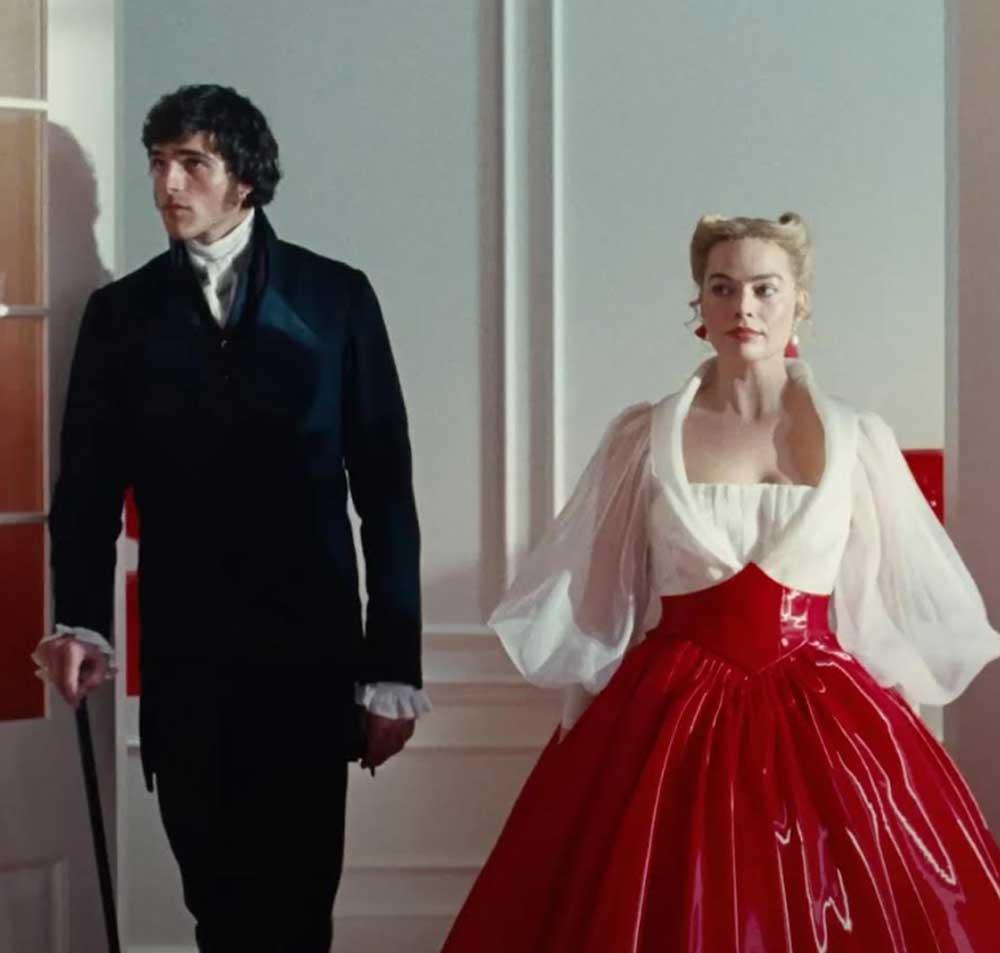
Visually, the film is sumptuous to the point of excess. The cinematography leans into high contrast lighting and tactile textures. Skin, fabric and landscape are all rendered with a sensuous clarity that makes the physical world feel oppressive and seductive at once. Interiors are heavy with shadow and candlelight. Exteriors are swept by wind and rain that seem to batter the characters into their own emotional extremes. The production design is meticulous, but it is also stylized. This is a heightened version of the nineteenth century, one that feels designed to mirror the characters’ internal chaos rather than to recreate a historically grounded environment. For some viewers, this will feel immersive and intoxicating. For others, it will feel mannered and over determined.
The soundtrack reinforces this modernized sensibility. Rather than leaning solely on traditional orchestral cues, the film incorporates contemporary musical textures that blur the boundary between period piece and modern psychodrama. In certain sequences, this anachronism works surprisingly well, underscoring the timelessness of obsession and emotional extremity. In others, it pulls the viewer out of the narrative, calling attention to the film’s desire to be seen as a bold reinterpretation rather than a story unfolding on its own terms. The music often tells you what to feel, and not all viewers will appreciate being guided so forcefully.
Where the film struggles most is in its treatment of theme. Brontë’s novel is not simply a story of doomed romance. It is a study of class cruelty, social exclusion, generational trauma and the cyclical nature of abuse. Fennell’s adaptation gestures at these ideas but rarely lingers on them. The Earnshaws and Lintons are presented as archetypes of privilege and repression, yet their social power is more atmospheric than interrogated. The cycle of cruelty that passes from one generation to the next is acknowledged but not fully dramatized, partly because the film’s narrative compression sidelines the younger characters who carry the novel’s moral evolution. What remains is the romance of destruction without the fuller moral context that makes that destruction meaningful rather than merely sensational.
This narrowing of focus also affects the film’s emotional payoff. Without the novel’s broader temporal sweep, the consequences of Catherine and Heathcliff’s choices feel abrupt. Their suffering is immediate and overwhelming, but it lacks the slow accretion of loss that gives the story its haunting aftertaste. The film is relentless in the present tense. It rarely pauses to let regret or reflection reshape the characters. For a story so deeply concerned with the long shadows cast by youthful cruelty and pride, this is a significant omission.
None of this is to say that Wuthering Heights 2026 is an artistic failure. It is a confident piece of filmmaking that knows exactly what kind of reaction it wants to provoke. Fennell is not interested in pleasing purists. She is interested in making the story feel dangerous and emotionally uncontained to a contemporary audience. In that sense, the film succeeds. It is visceral, confrontational and often hypnotic. There are sequences of genuine power, moments when the collision of performance, image and sound creates a sense of tragic inevitability that feels earned in the instant, even if it is not fully supported by the narrative architecture.
Ultimately, this adaptation will likely be remembered less as a definitive Wuthering Heights and more as a provocative reinterpretation that reflects its director’s sensibility as much as Brontë’s. For viewers who come to the film without deep attachment to the novel, it may register as a darkly romantic psychodrama with striking performances and a bold visual identity. For those who cherish the book’s moral complexity and narrative intricacy, it may feel like a beautiful but flattening translation, one that trades depth for intensity and reflection for spectacle. Either way, it is a film that insists on being argued with, and that, in itself, is part of its design.