AnchorSri Lanka’s Last Lacquer Workers
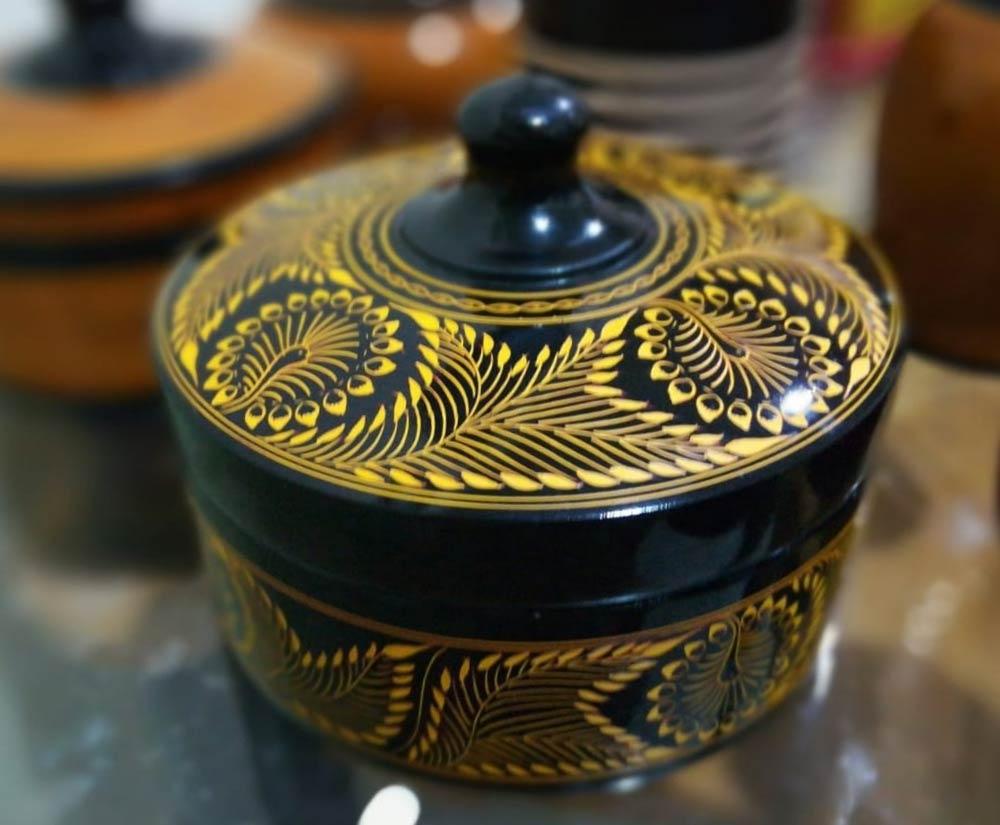
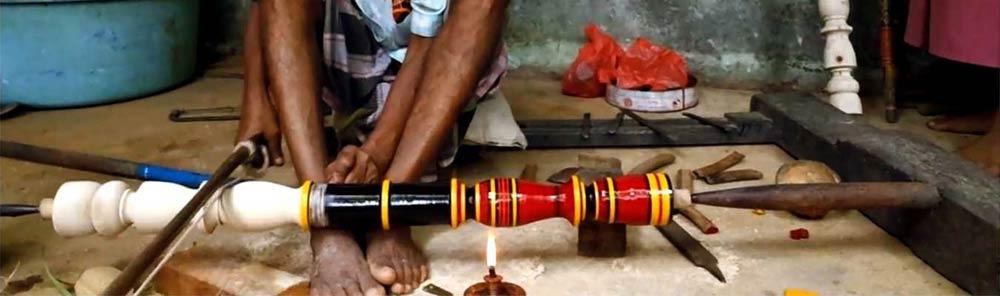
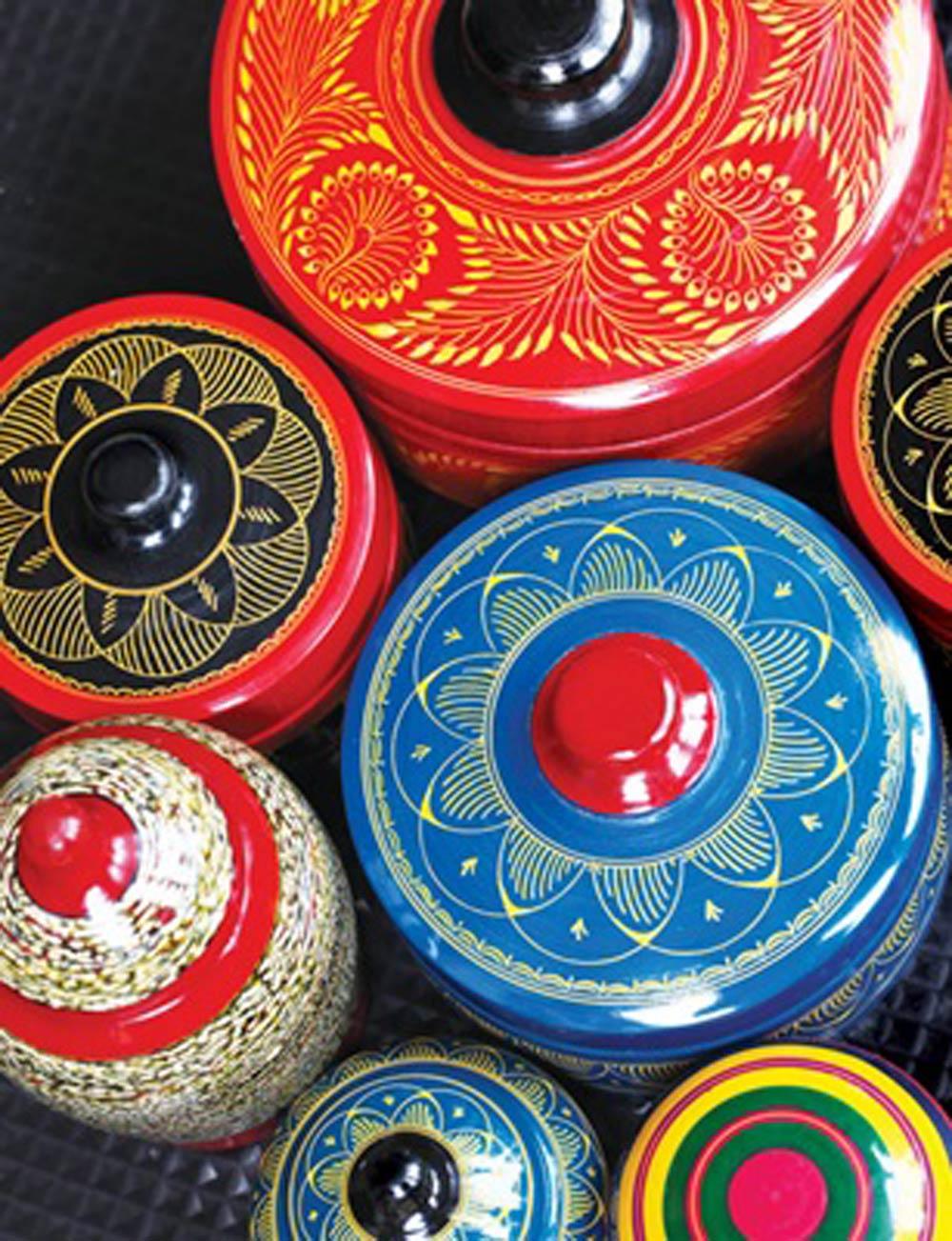
 There’s a hushed fervour in the workshop. A small group of artisans sit on the floor, quietly and meticulously carrying out their tasks. Some apply lacquer on objects that spin on low-slung lathes, while others warm resin and stretch it out into thin, long, glossy ribbons. Laksha, or lacquer making, is an heirloom craft, believed to have been introduced to the island around the same time Buddhism was brought. This craft was widely associated with royalty, and lacquer craftsmen played an integral role in the king’s armoury. Over time, they stopped making weapons and began making more decorative items, yet the craftsmanship and process remain largely unchanged. Walk into any souvenir shop around the island, and you’ll see rows of neatly lined wooden boxes, staves, candle holders, and bowls; their signature black, red and yellow paint gleaming in the light. Unfortunately, most of the items available today are not the real deal. Despite Laksha's cultural significance, it is slowly fading. The market is flooded with mass-produced, machine-made, cheaper alternatives, some of which don’t even use the natural resin the craft is renowned for. However, tucked away in the small village of Hapuwida in Matale, there’s a handful of artisans who keep this handcrafted tradition alive.
What Is Lacquer Work?
Lacquer work in Sri Lanka is a traditional art done to preserve wooden artefacts. It involves layering resin to produce a brilliant, protective surface. The process is slow by design, demanding patience at every stage. The lacquer is derived from secretions of lac insects found on native trees. Artisans have to collect the raw resin (which looks nothing like the glossy material you see at the end) by hand, ensuring they don’t damage the trees. Back in the workshop, the transformation begins. The crude lac is cleaned, crushed, and gently heated over a low flame. As it warms, the resin softens, releases its natural stickiness and becomes malleable. Impurities are strained out, and mineral pigments are worked in to produce the deep reds, blacks, greens, and ochres characteristic of Sri Lankan lacquerware. Since the craft has been passed down from generation to generation, the lac production process fuses science with instinct. It’s a careful dance; too much heat and the lacquer burns, too little and it remains unworkable. Experienced artisans judge the temperature by feel and smell rather than following an exact ‘recipe,’ kneading the softened resin into pliable sticks or sheets that can be stored for later use.
Transforming the Wood
The beauty of lacquer lies in how it transforms a simple wooden object into a beautiful artefact. Although lacquerware is not unique to Sri Lanka, our technique differs from other Asian countries. China, Japan and Korea use brush-painted lacquer techniques, whereas Sri Lankan lacquer is typically applied using two methods: rotating lathes or by hand.
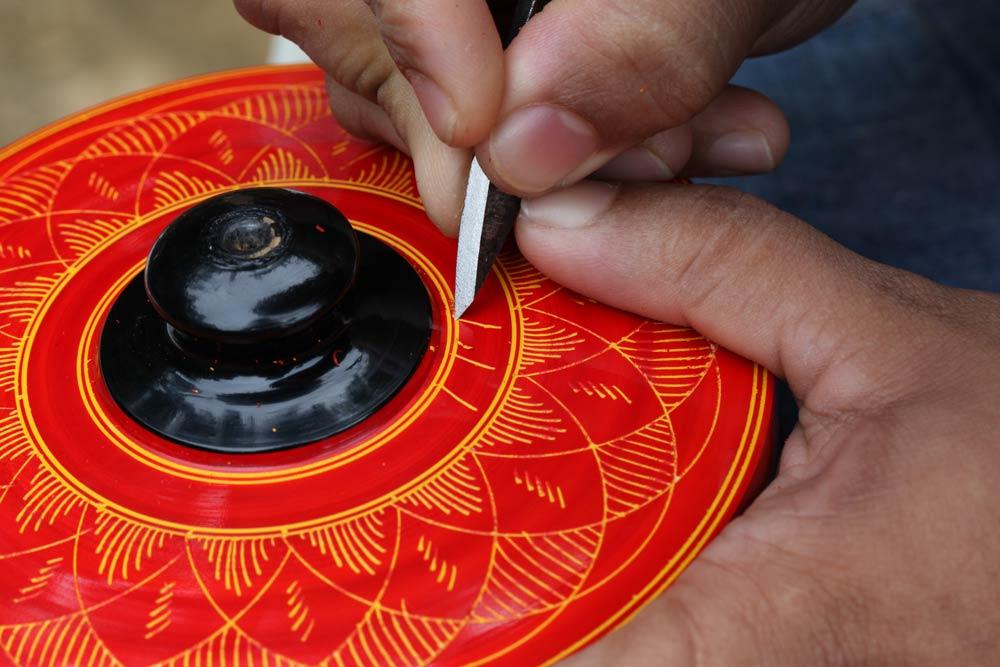
For the first method, solid lac is pressed against wood as it spins on a lathe, the friction softening the resin and laying down clean, concentric bands of colour. In contrast, Matale’s signature method, niyapoten veda, or “finger-nail work,” is slower and more intimate. Objects are first coated in a base colour (usually vermilion red) then decorated with fine strands of warmed lacquer, drawn out by hand, cooled briefly against the craftsman’s knee, and applied as the piece turns gently beneath steady fingers. Each line is shaped by pressure and finished with a precise nip of the nail, leaving the angular dots and sharp ends that make Matale lacquer unmistakable. Artisans who follow this method tend to have a long thumbnail so they can pinch the end of the lacquer. For the final step, the surface is reheated and smoothed with a talipot leaf, giving the signature shiny finish.
The Slow Fade
For centuries, lacquer work existed quietly across the island, but it was under the Kandyan kings that the craft truly flourished. Royal patronage elevated lacquer artisans to a vital role within the kingdom, with entire caste groups dedicated to producing finely finished arrows, bows, and ceremonial staves for the Kandyan army and court. This was knowledge inherited, not taught. Techniques, materials, and rhythms were carefully passed from parent to child, generation after generation, and even now the process is almost the same as that of their forefathers. Today, you’ll find lacquer work still being made, but this lineage is slowly unravelling. Fewer young people take up the tools, with less incentive to master a craft that takes years to learn and pays little in the early stages, so they turn to other more profitable trades. Handcrafted lacquerware also struggles to compete with mass-produced, machine-made goods. Uniformity and a shorter production time make machine-made pieces easier to price and sell. But doing so, they strip lacquer of the very imperfections that define its beauty. Some artisans have also opted to use imported chemically produced shellac, and this decision has altered both material and way of life, replacing slow processes with quicker substitutes. Another challenge these artisans face is that as more people prioritise speed and affordability, handcrafts become more expendable. The heritage handcraft industry is also very vulnerable to changes in the economy and tourism, as these workshops rely on tour groups, so tourism booms and busts have a direct impact on the traditional artisan. Recently, Cyclone Ditwah ravaged the country, and Matale and the village of Hapuwida were badly hit. Lives were lost, homes and workshops were damaged or destroyed and it may take some time till these workshops are able to operate again.
It’s Not Over
But lacquer work hasn’t entirely vanished, not yet. There are several workshops in Kandy, Matale, Hambantota and Kaltura that are still operating. Visiting one of these workshops offers a rare opportunity to experience lacquer work firsthand. To step into one of these workshops, it is more than witnessing a craft, it’s experiencing a part of our history.
From batik to brass making and lacquer to wood carving, Sri Lanka has a rich handcrafted heritage with a long history that is echoed through each object. In a world racing toward efficiency and mass production, lacquer work stands as a testament to the value of time and tradition. We must ensure Laksha doesn’t become only a memory in museum showcases.